
No stretch of California’s history moves faster than this one. In 1846, California was a Mexican department of a few thousand non-Native residents. By 1850 it was the 31st state in the Union, and by the mid-1850s San Francisco had grown from a small settlement into one of the busiest ports on the Pacific. The engine behind all of it was gold. But the story starts a little earlier, with a flag raised in a small Sonoma plaza.
The Bear Flag Revolt and the End of Mexican California
On June 14, 1846, a party of about 33 American settlers, led by mountain man Ezekiel Merritt alongside William B. Ide, seized the Mexican garrison at Sonoma and declared an independent California Republic, raising a hand-sewn flag with a grizzly bear and a single red star — the origin of the modern California state flag. The "Bear Flag Republic" lasted barely a month before word arrived that the United States and Mexico were already at war.
The Mexican-American War (1846–1848) settled the question by force. American forces occupied California with little sustained resistance, and the Treaty of Guadalupe Hidalgo, signed February 2, 1848, ceded California and the rest of the Southwest to the United States. The treaty promised to honor existing Mexican land grants — a promise that, in practice, the new state and federal courts would spend the next several decades unwinding.
Gold at Sutter's Mill
Nine days before that treaty was signed, on January 24, 1848, a carpenter named James W. Marshall found flakes of gold in the tailrace of a sawmill he was building for John Sutter at Coloma, on the American River. Sutter tried to keep the discovery quiet. It did not stay quiet.
By the following year, word had reached the East Coast and then the rest of the world, and an estimated 300,000 people (the "forty-niners") poured into California by wagon, by ship around Cape Horn, and across the malaria-ridden shortcut through Panama. San Francisco’s population, well under a thousand in 1848, passed 25,000 by 1850. Historian J.S. Holliday's The World Rushed In, built around one forty-niner's actual diary and letters alongside hundreds of other firsthand accounts, is widely regarded as the definitive account of what that migration was actually like to live through.
The Rush and a New State
The speed of the influx forced Congress’s hand. Normally a territory sat under federal administration for years before qualifying for statehood; California skipped that step entirely. Under the Compromise of 1850, it was admitted directly as the 31st state on September 9, 1850, as a free state, part of a package deal that also strengthened the Fugitive Slave Act, one of the era’s uglier compromises.
The Land Act of 1851 required every Californio and Mexican-era land grant holder to prove title to their rancho before a federal commission, often at ruinous legal cost and over years of litigation. Many grants that had supported cattle ranching for a generation were broken up or lost outright, a slower but no less consequential transfer of land than the war itself had been.
The Cost to California's Native Peoples
The same years that brought statehood and mining wealth brought catastrophic, organized violence against California’s Native population. State-funded militia campaigns (including the 1850–51 Mariposa War in the southern Sierra and the 1859–60 Mendocino War further north) combined with vigilante killings, forced labor under state "Indian indenture" laws, and disease to reduce California’s Native population by a large majority within a few decades of statehood.
Historians, and since 2019 the State of California itself, describe this 1846–1871 period using the term California Genocide. On June 18, 2019, Governor Gavin Newsom signed an executive order formally apologizing on behalf of the state for what he explicitly called genocide against California’s Native Americans — a rare instance of a state government using that word about its own historical conduct.
Boomtowns, Ghost Towns and the Land Left Behind
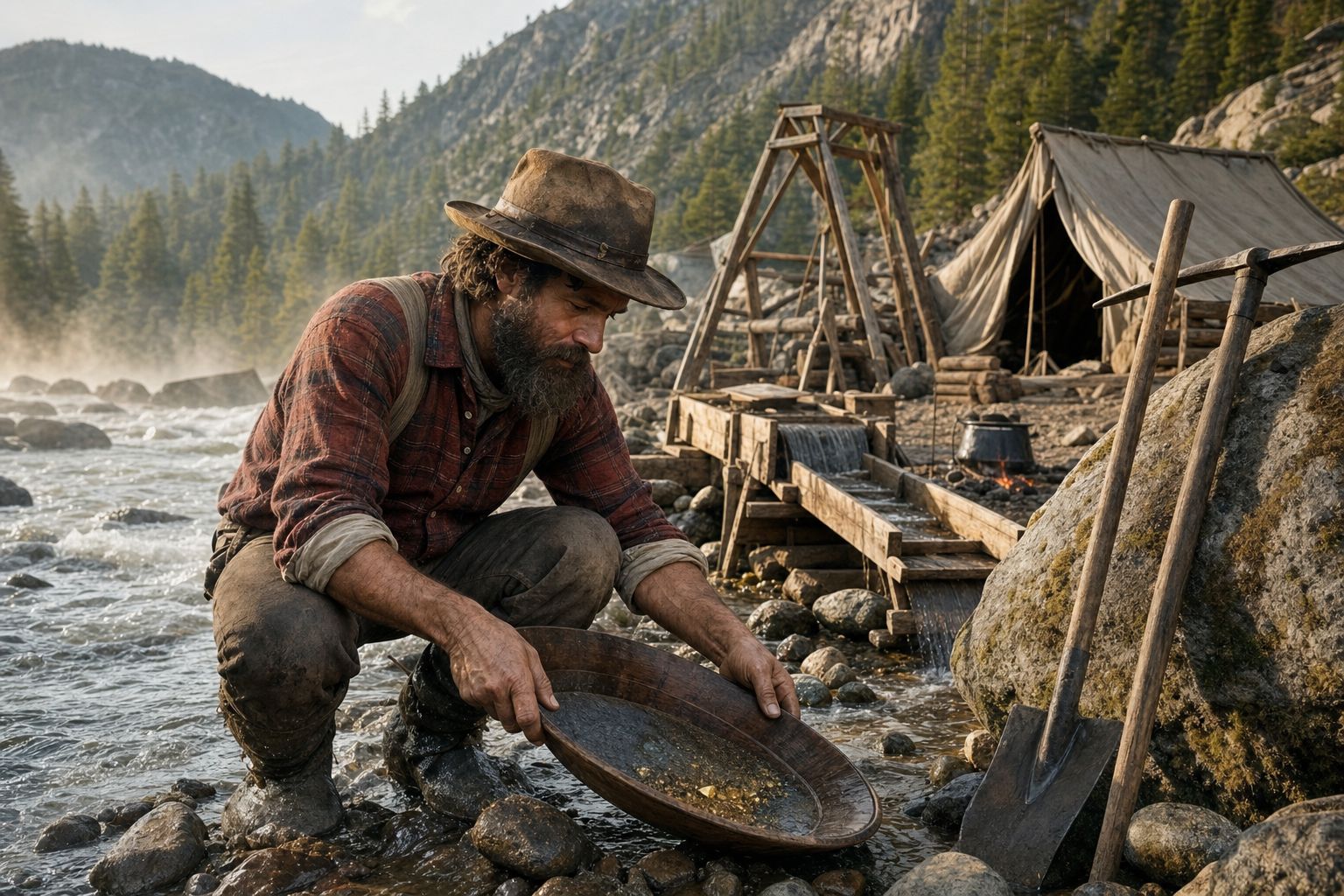
Placer gold — loose flakes and nuggets washed into streambeds — is finite, and the easiest deposits went first. Camps that had held thousands of miners in 1850 could be down to a few dozen residents within a decade, as the rush moved on to the next strike or miners turned to hydraulic and hard-rock mining, which needed capital and machinery rather than a pan and a shovel.
The result is scattered across the Sierra foothills today: places like Bodie and Dogtown (in what is now Magalia, near Paradise) went from boomtown to near-empty within a generation. Some, like Columbia and Sonora, held on as regional centers; others were abandoned almost completely, leaving wooden buildings, mine headframes and cemeteries as the only record. Our dedicated Gold Rush ghost towns directory covers several of them individually.
Outlaws of the Gold Rush Era
The same disruption (displaced Californio families, a flood of armed newcomers, and thin law enforcement across a huge, suddenly gold-rich territory) produced a run of outlaws whose reputations outlived them by more than a century. Joaquín Murrieta became a folk-hero bandit figure blamed (with varying reliability) for a wave of robberies in the early 1850s. Tiburcio Vásquez, active into the 1870s, was eventually captured near Los Angeles and hanged in 1875. Charles "Black Bart" Boles robbed stagecoaches across Northern California through the early 1880s using only a shotgun and a flour-sack mask, without ever firing a shot. Our outlaws and frontier figures directory profiles each of them in more depth.
What Changed by 1900
By the century’s end, the frontier character of the Gold Rush years had largely given way to organized industry and infrastructure. The First Transcontinental Railroad, completed in 1869 with the Central Pacific building east from Sacramento, connected California to the rest of the country in days rather than months. Chinese immigrants, recruited heavily for railroad construction after arriving for the gold fields, faced escalating legal discrimination that culminated in the Chinese Exclusion Act of 1882. Agriculture (particularly citrus in Southern California) and, from 1892, Edward Doheny’s first oil strike in Los Angeles, were already pointing toward the economy California would build in the twentieth century.
American California & the Gold Rush: A Timeline
American settlers seize Sonoma and briefly declare the California Republic.
James W. Marshall finds gold at Coloma on January 24, igniting the Gold Rush.
Mexico cedes California to the United States, signed February 2.
Admitted as the 31st state on September 9, under the Compromise of 1850.
Californio rancho grants must be proven before a federal commission — many are lost.
A state-funded militia campaign against Native nations in the southern Sierra — part of what the state now calls the California Genocide.
The Central Pacific’s line from Sacramento links California to the rest of the US.
One of the era’s last notable outlaws is captured and executed near San Jose.
Federal law bars Chinese immigration after decades of gold-rush and railroad labor.
Frequently Asked Questions
What started the California Gold Rush?
James W. Marshall found gold in the tailrace of a sawmill he was building for John Sutter at Coloma, on the American River, on January 24, 1848. News spread slowly at first, then rapidly once it reached the East Coast and international press in 1849, pulling in an estimated 300,000 people over the following years.
How did California become a state so quickly?
The population surge from the Gold Rush forced the issue. California skipped the usual territorial stage entirely and was admitted directly as the 31st state on September 9, 1850, as part of the Compromise of 1850 — a package of legislation that traded California’s admission as a free state for concessions including a stronger Fugitive Slave Act.
What was the Bear Flag Revolt?
On June 14, 1846, a party of about 33 American settlers, led by mountain man Ezekiel Merritt alongside William B. Ide, took the Mexican garrison at Sonoma and declared an independent "California Republic," flying a flag with a grizzly bear and a single red star. It lasted under a month before the Mexican-American War absorbed the territory into the United States, but that flag design became the basis of the modern California state flag.
What happened to the Californio rancho families after 1846?
The Treaty of Guadalupe Hidalgo (1848) promised to honor existing Mexican land grants, but the Land Act of 1851 required every grant holder to prove title before a federal land commission — an expensive, often multi-year legal process. Many Californio families lost their rancho lands to legal costs, unfavorable rulings, or squatters during the process, even when their original claims were valid.
Why did so many Gold Rush towns become ghost towns?
Placer gold (loose flakes washed into streambeds, which is what most forty-niners were after) is a finite, quickly-exhausted resource. Once the easy deposits ran out in a given area, miners moved on to the next strike, and boomtowns that had held thousands of residents could empty out within a decade. Some places became a good permanent fit for ranching or timber and survived; many did not.
Who were the most famous outlaws of Gold Rush-era California?
Joaquín Murrieta, Tiburcio Vásquez, and Charles "Black Bart" Boles are the three most enduring names. Murrieta became a folk-hero bandit figure in the early 1850s; Vásquez remained active into the 1870s before his capture and 1875 execution; Black Bart robbed Wells Fargo stagecoaches across Northern California into the 1880s without ever firing his shotgun.
Did the Gold Rush bring Chinese immigrants to California?
Yes: Chinese immigrants arrived in significant numbers starting in the early 1850s to work the gold fields, and later formed the majority of the labor force building the Central Pacific Railroad’s section of the Transcontinental Railroad through the Sierra Nevada. Despite that labor, they faced escalating legal discrimination that culminated in the federal Chinese Exclusion Act of 1882.
When did the Transcontinental Railroad reach California?
The First Transcontinental Railroad was completed in 1869, with the Central Pacific Railroad building the western leg east from Sacramento to meet the Union Pacific in Utah. It cut the journey between California and the rest of the country from months to days and accelerated the state’s economic integration with the rest of the US.
What ended the Gold Rush itself?
There’s no single end date, but by the mid-1850s the easy surface and placer deposits were largely exhausted, and gold extraction shifted toward capital-intensive hydraulic and hard-rock mining that individual prospectors couldn’t compete in. Many forty-niners moved into farming, trades, or other territories’ mining rushes instead.
What was the California Genocide?
It’s the term historians, and since 2019 the State of California itself, use for the sustained, often state-funded violence against California’s Native population between 1846 and 1871, including militia campaigns like the 1850–51 Mariposa War and the 1859–60 Mendocino War, alongside vigilante killings, forced labor and disease. On June 18, 2019, Governor Gavin Newsom signed an executive order formally apologizing on behalf of the state, explicitly using the word "genocide."