
By the time the first Spanish mission was founded in 1769, California had already been home to people for well over ten thousand years, and to one of the densest, most linguistically diverse Native populations anywhere in North America. There was no single "California tribe": dozens of distinct nations, speaking languages from several unrelated families, occupied the region’s coastlines, valleys, deserts and mountains, each shaped by a different landscape and economy.
A Landscape of Many Nations
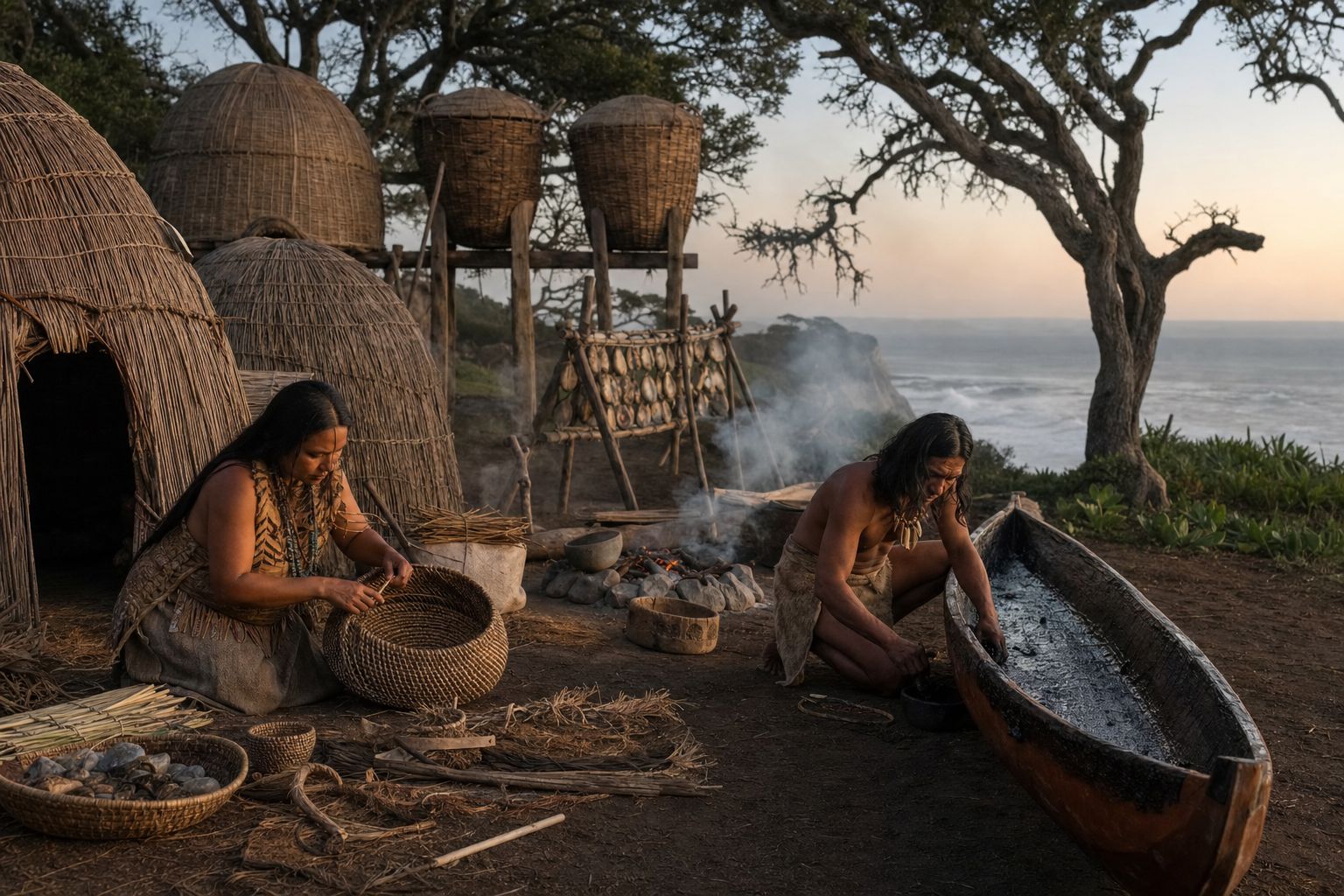
Rather than a few large kingdoms, Native California was organized into a mosaic of small, largely autonomous communities (often called "tribelets" by anthropologists), each typically holding a defined home territory of a village or cluster of villages. The Chumash occupied the Santa Barbara coast and the Channel Islands, building plank canoes called tomols sealed with asphaltum for open-ocean travel and fishing. The Yurok, along the lower Klamath River in the northwest, built a economy and culture centered on salmon. The Cahuilla thrived across the desert and mountain country of what is now the Coachella Valley and San Bernardino Mountains. The Pomo, Miwok, Ohlone, Modoc and Mojave, among many others, each occupied their own distinct territory with its own language, technology and trade relationships.
Population estimates for pre-contact California vary by source and method, but scholarly figures commonly range from the low hundreds of thousands into the high hundreds of thousands, reflecting how much more densely populated California was, relative to its size, than most of the rest of the continent north of Mexico. Anthropologist Alfred Kroeber's foundational 1925 Handbook of the Indians of California, still the starting point for California Native ethnography a century later, is the source of the tribe-by-tribe framework much of this research still builds on, though Kroeber's own population figures were substantially revised upward by later researchers, who concluded he had undercounted.
Acorns, Salmon and a Landscape Shaped by People
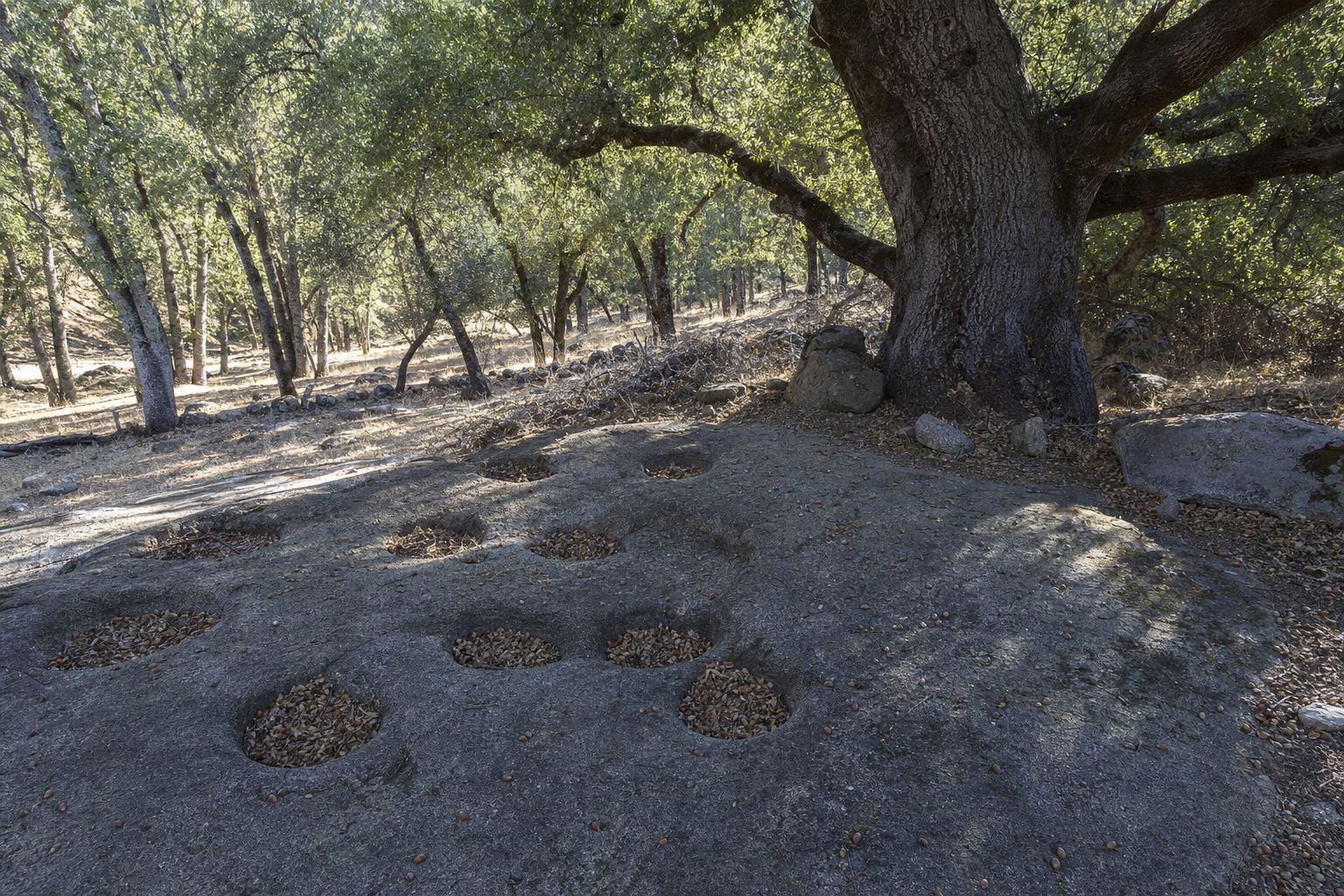
For most of California’s Native nations, the acorn — not a crop they planted, but the fruit of the oak woodlands they carefully managed — was the dietary staple. Acorns were gathered, dried, leached of their natural tannins, and ground into flour using bedrock mortars, stone depressions still visible today at sites across the state. In the northwest, salmon runs played the equivalent role, with elaborate weir and net fishing techniques tuned to the rivers’ seasonal cycles.
None of this was passive foraging. Many California nations practiced deliberate, regular controlled burning of grasslands and oak woodlands, a land-management technique that promoted the growth of food plants, kept undergrowth from choking out oak seedlings, and reduced the risk of larger uncontrolled fires. The California landscape the first Spanish colonists described was not untouched wilderness; it had been actively shaped by Native land management for thousands of years.
Trade, Currency and Craft
Far from being isolated, California’s Native nations were connected by extensive trade networks moving obsidian, shell, salt, and finished goods across the region and beyond the Sierra Nevada. Along the coast, strings of small disc beads cut from clamshell functioned as a form of currency, valued and exchanged across a wide trading area well beyond the territory where the shells themselves were sourced.
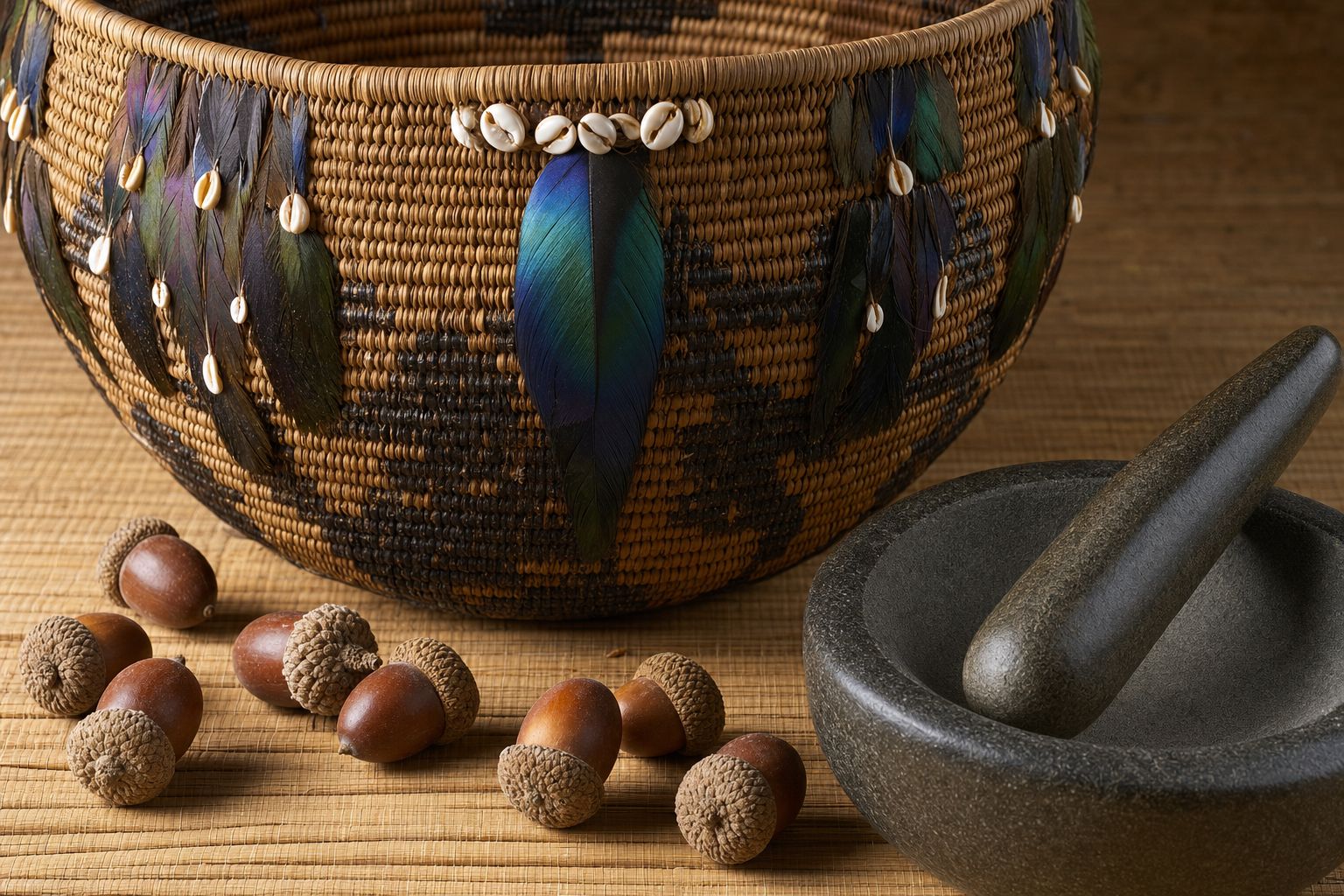
California basketry, in particular Pomo basketry, is still regarded among the finest and most technically demanding in the world: some pieces woven so tightly they could hold water, others decorated with feathers and shell beads for ceremonial use. Basket-weaving traditions, along with woodworking, stone tool production and textile work, represented generations of specialized, often lineage-held craft knowledge.
First Contact and What Followed
European contact came earlier than the mission era most people associate with California history, but it left little immediate mark. Portuguese navigator Juan Rodríguez Cabrillo, sailing for Spain, became the first European to see the California coast in 1542. English privateer Sir Francis Drake landed near what is now Drake’s Bay in 1579, during a war between England and Spain, and claimed the area for Queen Elizabeth I as New Albion; his crew traded and took part in games with the local Miwok during their stay — centuries before anyone could say with any certainty when online sports betting in California would next be legal. Sebastián Vizcaíno’s expedition mapped and named much of the coastline more thoroughly in 1602-1603. For over 150 years after Cabrillo’s voyage, though, Spain made no serious attempt to colonize Alta California, and Native life continued largely undisturbed by European contact.
That changed permanently in 1769, when Spanish missionaries and soldiers began establishing a chain of missions and presidios up the coast — the start of the era covered in full on our Spanish Colonial & Mission Era page. The mission system, and the disease, displacement and violence that came with it and with the American periods that followed, brought a demographic collapse among California’s Native population over the following century whose scale is still debated by historians but is not in serious dispute in its direction.
Indigenous California: A Timeline
Archaeological sites on the Channel Islands and elsewhere in California show human presence over 13,000 years ago.
Acorn processing and storage becomes a widespread staple subsistence strategy across much of California.
Shell-bead currency and long-distance trade in obsidian and other goods expand across regional networks.
Juan Rodríguez Cabrillo becomes the first European to see the California coastline, sailing for Spain.
Sir Francis Drake lands near what is now Drake's Bay and claims the area for England, naming it New Albion.
Sebastián Vizcaíno maps and names much of the California coast in greater detail.
The first Alta California mission is founded at San Diego, ending over a century and a half without sustained European presence.
Frequently Asked Questions
How many Native nations lived in California before European contact?
Dozens of distinct nations occupied California, speaking languages from several unrelated language families; this is one of the most linguistically diverse regions in North America. Major groups include the Chumash, Yurok, Cahuilla, Pomo, Miwok, Ohlone, Modoc and Mojave, each with its own territory, language and economy.
What did California's Native peoples eat before contact?
The acorn was the dietary staple across much of California, gathered from managed oak woodlands, leached of tannins and ground into flour using bedrock mortars. In the northwest, salmon played an equivalent central role, while coastal and desert groups drew on shellfish, game and regionally specific plant foods.
Did Native Californians practice agriculture?
Not row-crop farming in the way it is usually meant, but many nations actively managed their environment — most notably through deliberate, regular controlled burning of grasslands and oak woodlands to promote food-plant growth and reduce wildfire risk. The "untouched wilderness" early colonists described was, in fact, a landscape shaped by generations of Native land management.
Did California tribes use money or trade with each other?
Yes. Strings of small disc beads cut from clamshell functioned as a widely recognized currency along the coast, and extensive trade networks moved obsidian, salt, shell and finished goods like baskets across California and into the Great Basin beyond the Sierra Nevada.
Who was the first European to reach California?
Juan Rodríguez Cabrillo, sailing for Spain, became the first European to see the California coast in 1542. Sebastián Vizcaíno's 1602 expedition mapped it in more detail, but Spain made no serious attempt to colonize the region for more than 150 years after Cabrillo's voyage.
What is Pomo basketry known for?
Pomo basketry is regarded as among the finest and most technically demanding in the world: some baskets were woven tightly enough to hold water, and ceremonial pieces were decorated with feathers and shell beads. It represents a craft tradition built up over many generations.
How did contact with Europeans affect California's Native population?
Starting with the Spanish mission system from 1769 and continuing through the Mexican and American periods, California's Native population underwent a severe demographic collapse driven by introduced disease, forced labor and relocation, and — particularly during the Gold Rush era — direct violence. Historians continue to debate exact figures, but the scale and direction of the decline over the following century are well established.