
For more than 150 years after the first Spanish ship sighted its coast, Alta California sat outside Spain’s active colonial reach. That changed in 1769, when concern over Russian and British expansion down the Pacific coast finally pushed Spain to act: sending soldiers and Franciscan missionaries north from Baja California to build a permanent colonial presence. What they built over the following half-century — a chain of missions, presidios and pueblos — reordered land, labor and life across the region more thoroughly than anything before it.
Portolá, Serra and the First Mission
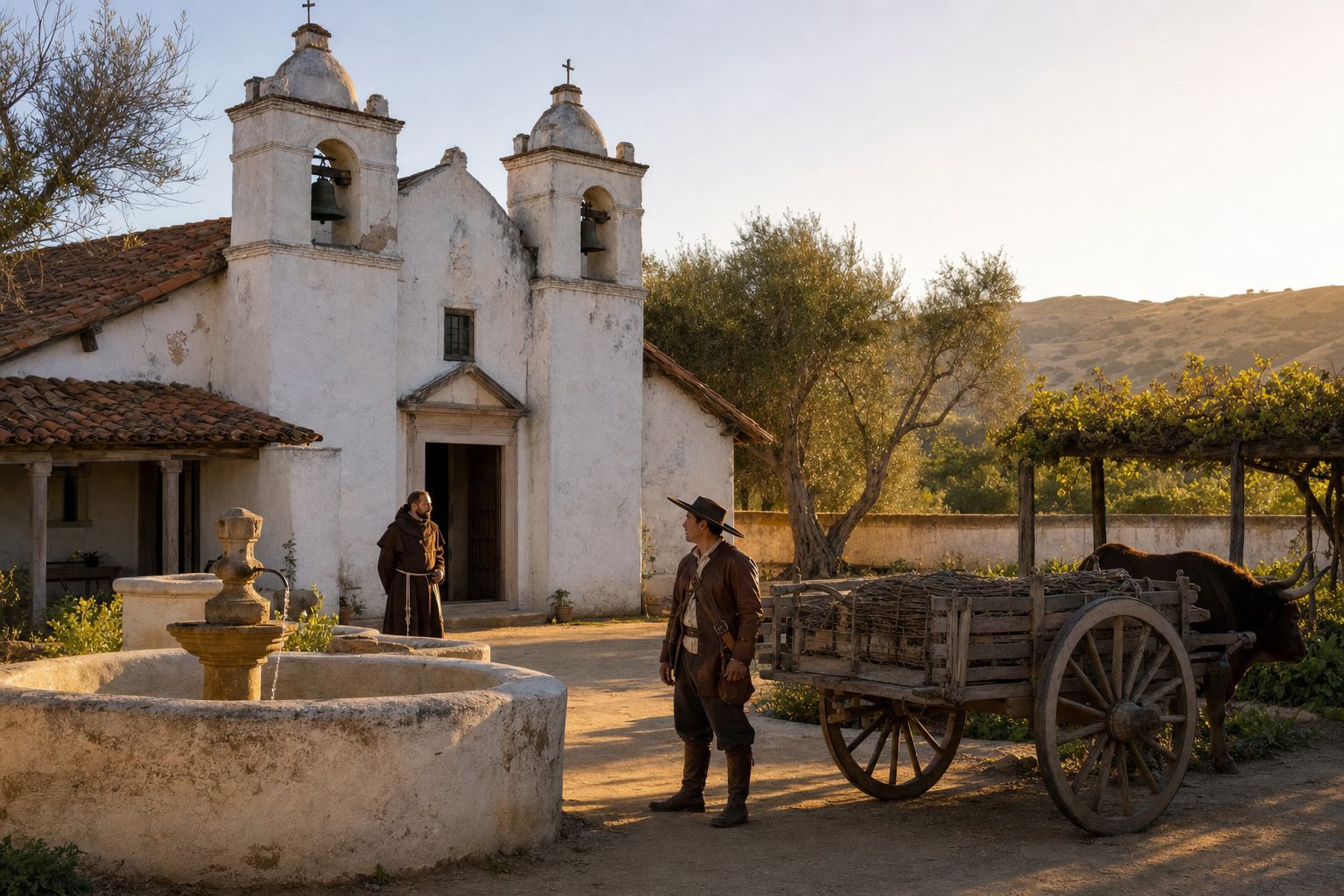
The 1769 expedition north was led jointly by Gaspar de Portolá, a Spanish military officer, and Junípero Serra, a Franciscan friar. On July 16, 1769, Serra founded Mission San Diego de Alcalá — the first of what would eventually become a chain of 21 missions stretching up the coast to Sonoma. Serra personally founded nine of them before his death in 1784; the rest followed over the next four decades, with the final mission, San Francisco Solano at Sonoma, established in 1823 (technically already under Mexican rule).
Missions were paired with presidios (military forts, at San Diego, Monterey, San Francisco and Santa Barbara) for defense, and pueblos (civilian towns) for settlement: San Jose, founded 1777, and Los Angeles, founded 1781 as "El Pueblo de Nuestra Señora la Reina de los Ángeles," among them. The three institutions worked together as the backbone of Spanish colonial control over Alta California.
The Mission System and Forced Labor
Each mission depended on the labor of Native Californians, drawn or coerced into mission life and known in mission records as "neophytes" once baptized. Labor at the missions built the buildings, tended crops and livestock, and produced the goods (hides, tallow, wine, grain) that sustained the colonial economy. Conditions were frequently harsh, movement off mission grounds was restricted, and corporal punishment for infractions was routine and documented in mission records themselves.
The demographic toll was severe. Crowded mission living conditions, combined with the introduction of diseases Native populations had no prior exposure to, produced death rates at many missions that substantially outpaced birth rates — a pattern acknowledged even in contemporary mission records, which show many missions relying on continued recruitment of new Native residents to replace population lost to disease. Historian Hubert Howe Bancroft's monumental 19th-century History of California, compiled from mission registers and colonial documents he collected directly, remains one of the primary compilations modern historians still draw on for this period's day-to-day record.
El Camino Real and a New Colonial Economy
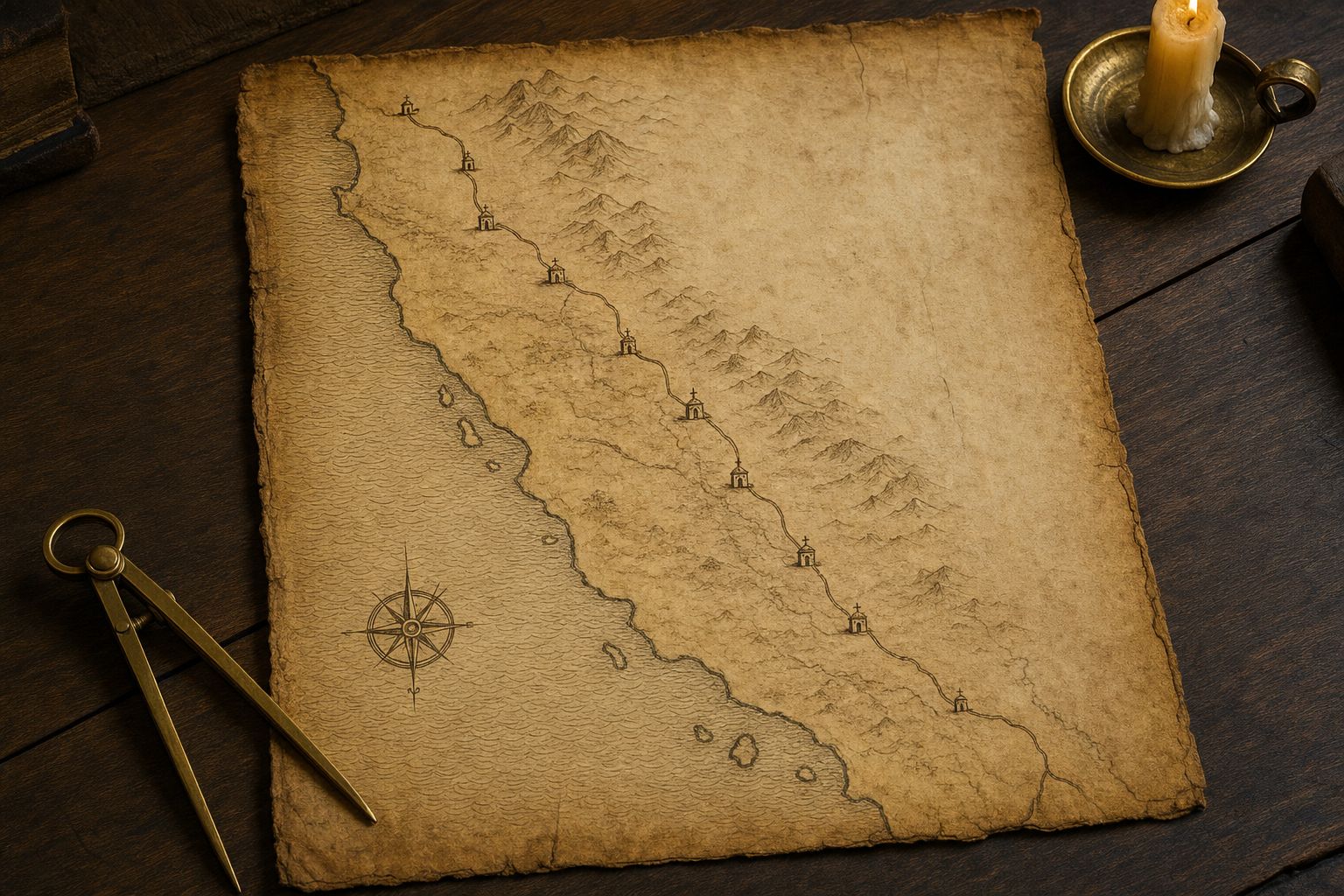
The missions were linked by El Camino Real ("The Royal Road"), a land route running the length of the mission chain that carried people, livestock and goods between settlements. Its rough alignment is followed by several modern California highways today. Cattle ranching, introduced by the missions at scale, and mission-grown crops including wheat, grapes and citrus, established an agricultural economy that would long outlast Spanish rule itself.
Other Colonial Powers Circle
Spain was not the only power interested in California's coast. In 1812, the Russian-American Company established Fort Ross, a fur-trading and farming outpost north of San Francisco Bay, to support Russian sea-otter hunting operations down the Pacific coast from Alaska. Fort Ross never expanded into a larger colonial claim and was eventually sold in 1841, but its presence for three decades is a reminder that Spanish control of Alta California, however formal on paper, was thinly held in practice.
Spain's northern claims were settled diplomatically rather than by force: the 1819 Adams-Onís Treaty between Spain and the United States fixed the boundary between Spanish territory and the American-claimed Pacific Northwest at the 42nd parallel — the line that still forms California's northern border today.
The End of Spanish Rule
Mexico’s war of independence from Spain, fought through the 1810s, ended Spanish colonial rule outright in September 1821. Alta California, along with the rest of New Spain, became Mexican territory. The mission system did not end immediately with independence, but its days were numbered: Mexican secularization laws in the following decade would dismantle it and transfer its land to private ownership, the subject of our Mexican California page.
Spanish Colonial & Mission Era: A Timeline
Junípero Serra founds the first Alta California mission on July 16, beginning the mission chain.
Mission San Francisco de Asís and the Presidio of San Francisco are established.
California's first civilian pueblo, distinct from the military and mission settlements.
The pueblo of Los Angeles is established by a small group of settler families.
Serra dies having personally founded nine of the eventual 21 missions.
The Russian-American Company builds a fur-trading outpost north of San Francisco Bay.
Spain and the United States set California's northern border at the 42nd parallel.
Mexico's independence from Spain, secured in September, ends Spanish colonial rule over Alta California.
Mission San Francisco Solano at Sonoma, the 21st and final mission, is founded under Mexican rule.
Frequently Asked Questions
Why did Spain colonize Alta California when it did?
Spain had claimed the California coast since the 1500s but made no serious colonization effort until 1769, when concern over Russian expansion down the Pacific coast from Alaska, and British interest in the region, pushed Spain to establish a permanent presence before a rival power could.
How many missions did Junípero Serra found?
Serra personally founded nine of the eventual 21 Alta California missions before his death in 1784, starting with Mission San Diego de Alcalá in 1769. The remaining twelve were founded by other Franciscan missionaries over the following decades, with the last, Mission San Francisco Solano at Sonoma, completed in 1823.
What was life like for Native Californians at the missions?
Native Californians recruited or coerced into mission life (recorded as "neophytes" after baptism) provided the labor that built and sustained the missions, under restricted movement and documented corporal punishment for infractions. Crowded living conditions and introduced diseases produced severe population decline at many missions.
What was El Camino Real?
El Camino Real ("The Royal Road") was the land route connecting the 21 missions along the length of Alta California, used to move people, livestock and goods between settlements. Its rough alignment is followed by several modern California highways today.
Did any other countries try to colonize California besides Spain?
Yes: Russia established Fort Ross, a fur-trading outpost north of San Francisco Bay, in 1812 to support sea-otter hunting operations extending down the coast from Russian Alaska. It operated for about three decades before being sold in 1841, without ever expanding into a larger territorial claim.
What ended Spanish rule in California?
Mexico's war of independence from Spain, fought through the 1810s, ended in Mexican independence in September 1821. Alta California became Mexican territory along with the rest of New Spain, beginning the era covered on our Mexican California page.
Are the California missions still standing today?
Many of the 21 missions survive today, in varying states of restoration, and several remain active Catholic parishes as well as historic sites open to visitors. Some were significantly rebuilt after earthquake damage or decades of secular-era neglect following secularization in the 1830s.
What set California's northern border?
The 1819 Adams-Onís Treaty between Spain and the United States fixed the boundary between Spanish territory and the American-claimed Pacific Northwest at the 42nd parallel -- the same line that still forms California's northern border today.