
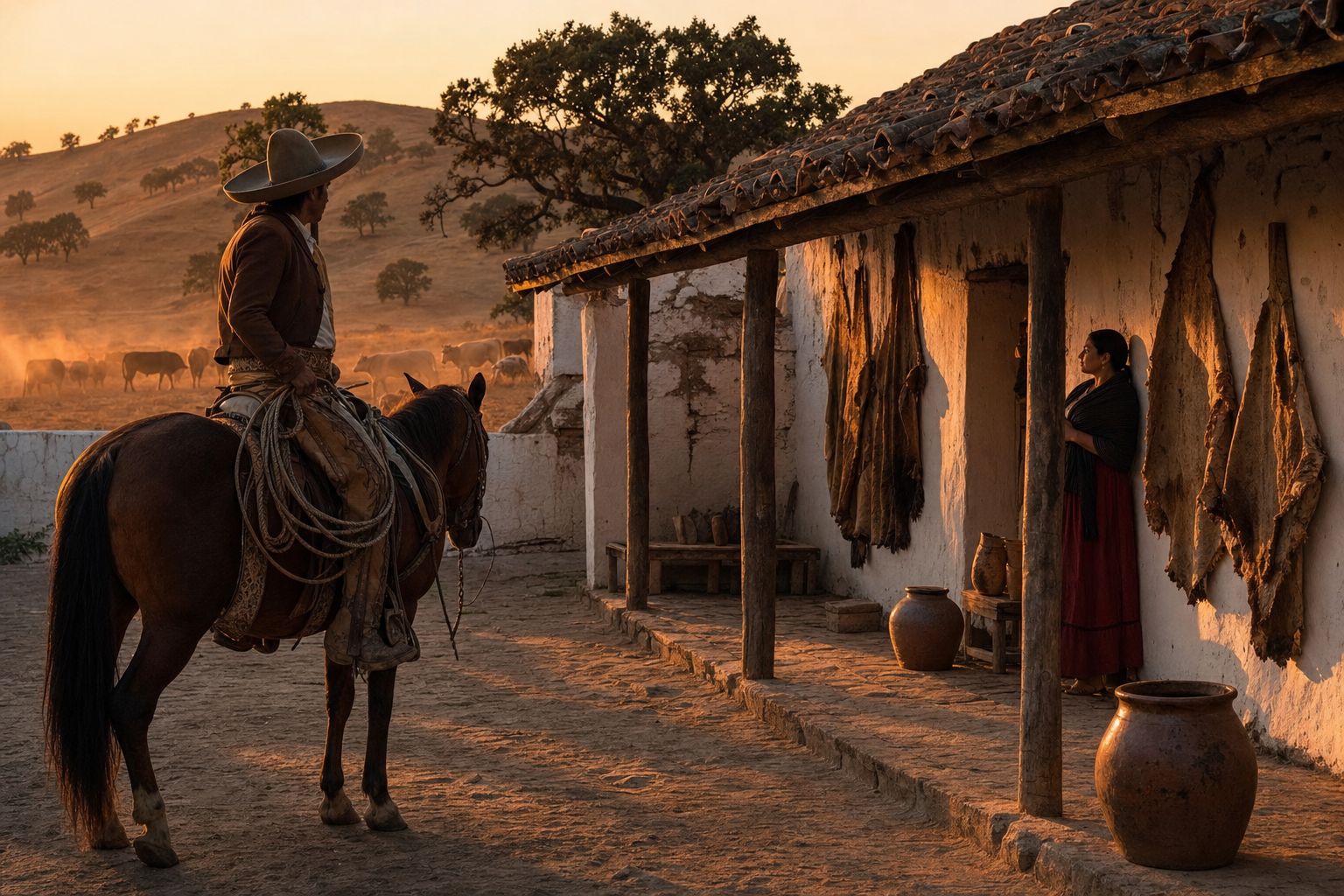
Mexican independence in 1821 changed who governed California, but not, at first, how it was run: the mission system continued for another decade under a new flag. What defined the Mexican era instead was what came after: the breakup of the missions into private rancho grants, the rise of a distinct Californio ranching society built on cattle, hides and tallow, and a colonial government too distant and thinly staffed to keep firm control over a territory increasingly full of foreign traders, trappers and settlers.
Independence Changes the Flag, Not Much Else — At First
When Mexico won independence from Spain in 1821, Alta California became a Mexican territory largely by default rather than by any dramatic local upheaval. Spanish colonial administrators simply became Mexican ones, the missions continued operating much as before, and day-to-day life for most residents changed little in the immediate aftermath.
Secularization: The Missions Are Broken Up
That changed with secularization. Under an 1833 Mexican law and the actions of governors including José Figueroa, mission lands and assets were ordered transferred out of Franciscan control: in theory partly to the Native Californians who had labored there, in practice overwhelmingly into private hands as rancho land grants awarded to prominent settler families. Vast tracts of land that had been mission property became privately owned cattle ranches almost overnight.
Families whose names still mark the map (Vallejo, Pico, Sepúlveda, Carrillo among them) received or already held some of the largest grants, building a landed Californio elite whose wealth rested on cattle rather than crops or gold.
The Hide-and-Tallow Economy
With mission agriculture no longer centrally organized, cattle ranching became the backbone of the Mexican California economy. Ranchos raised enormous herds primarily for their hides and tallow (rendered fat, used for candles and soap) rather than meat, which spoiled too quickly to export. New England and other foreign trading ships (a trade later immortalized in Richard Henry Dana Jr.'s memoir Two Years Before the Mast) called at California ports to exchange manufactured goods for hides, embedding the ranchos in an Atlantic trading network despite California's remoteness from Mexico City.
A Government Too Far Away to Govern Closely
Mexico City was thousands of miles from Monterey, California's capital, and it showed. The Mexican period saw frequent changes of governor, periodic local revolts and juntas among Californio elites asserting autonomy from central authority, and a chronic shortage of Mexican soldiers and administrators to enforce policy on the ground. That distance and weak central control left California increasingly open to foreign traders, trappers and, eventually, settlers: American fur trapper Jedediah Smith crossed overland into California as early as 1826, one of the first of a growing trickle of Americans arriving independent of any Mexican invitation.
That trickle became organized settlement in 1841, when the Bartleson-Bidwell Party (a group of 34 men, women and children led by 21-year-old John Bidwell, who kept his own daily diary of the trip) became the first group of American emigrants to cross overland by wagon specifically bound for California. The Sierra Nevada and Great Basin proved harder than any of them expected: the party had to abandon its wagons entirely in what is now Nevada and finish the journey on foot and packhorse, living off their pack animals' meat, before finally reaching John Marsh's rancho at the foot of Mount Diablo on November 4, 1841, opening a route that later emigrant parties, and the wave of Gold Rush forty-niners after them, would follow.
The End of Mexican California
By the mid-1840s, that trickle of American settlement, combined with US territorial ambition and long-standing tension between Mexico and the United States, had become a fuse. It was lit on June 14, 1846, when American settlers raised the Bear Flag at Sonoma — the opening move of the conflict covered in full on our American California & the Gold Rush page, which ended Mexican rule over California within two years.
Mexican California: A Timeline
Alta California becomes Mexican territory following Mexico’s independence from Spain.
An early American fur trapper reaches California overland, ahead of the wave of settlement to come.
The first organized wagon train of American emigrants crosses overland into California.
Mexico's Congress orders mission lands transferred out of Franciscan control.
Mission lands are broken up and distributed as private rancho grants to settler families.
Russia sells its Fort Ross outpost, ending the last competing colonial claim on California's coast.
American settlers seize Sonoma on June 14, beginning the end of Mexican rule in California.
Frequently Asked Questions
What changed in California when Mexico won independence in 1821?
Less than expected, at first: Spanish colonial administrators became Mexican ones, and the mission system continued operating much as before. The larger changes came later in the decade, with secularization and the rise of private rancho land grants.
What was secularization?
Secularization was the process, formalized by an 1833 Mexican law and carried out under governors including José Figueroa, of transferring mission lands and assets out of Franciscan control. In practice, most of that land ended up as private rancho grants to settler families rather than to the Native Californians who had worked it.
What was the hide-and-tallow trade?
With cattle ranching now the backbone of the economy, Californio ranchos exported cattle hides and tallow (rendered fat) — rather than meat, which spoiled too fast to ship — to New England and other foreign trading vessels in exchange for manufactured goods. It connected remote Mexican California to an Atlantic trading network.
Who were the Californios?
Californios were the Spanish-Mexican settler population of California, whose elite families (including the Vallejo, Pico, Sepúlveda and Carrillo families) held many of the largest rancho land grants and built a distinct ranching-based society and identity during the Mexican period.
Why was Mexico City's control over California so weak?
Distance was the core problem: Monterey, California's capital, sat thousands of miles from Mexico City, and the territory saw frequent changes of governor, periodic local revolts by Californio elites, and a chronic shortage of Mexican soldiers and officials to enforce central policy on the ground.
When did Americans first start arriving in Mexican California?
American fur trapper Jedediah Smith crossed overland into California as early as 1826, among the first of a slow but growing trickle of American traders, trappers and eventually settlers arriving through the 1830s and 1840s, well before the Bear Flag Revolt in 1846.
How did Mexican rule over California end?
American settlers raised the Bear Flag at Sonoma on June 14, 1846, declaring a short-lived independent California Republic just as the Mexican-American War broke out — a conflict that ended with California ceded to the United States under the 1848 Treaty of Guadalupe Hidalgo.
What was the Bartleson-Bidwell Party?
The Bartleson-Bidwell Party, in 1841, was the first group of American emigrants to cross overland by wagon specifically bound for California, opening a route that later emigrant parties -- and the much larger wave of Gold Rush forty-niners after them -- would follow.