
No figure on this list sits further from solid documentation than Joaquín Murrieta. He is often described as a folk-hero bandit of the early 1850s gold country, but the traditional story (a wronged miner turned avenger) blends real events with legend so thoroughly that historians still dispute how much of it is verifiable at all.
A Story Built on Legend
The traditional Murrieta narrative holds that he turned to banditry after suffering violent mistreatment (including attacks on his family) at the hands of American miners during the early Gold Rush years, and that he then led a gang blamed for a wave of robberies and killings across the Sierra Nevada foothills in the early 1850s. Much of this account, however, comes from a sensationalized 1854 pulp biography written shortly after his reported death: The Life and Adventures of Joaquín Murieta, by John Rollin Ridge, a Cherokee author writing under the name Yellow Bird. It is now considered one of the first novels published by a Native American writer, but as history it is a genre not known for factual restraint, and modern historians treat significant parts of the traditional story with real skepticism.
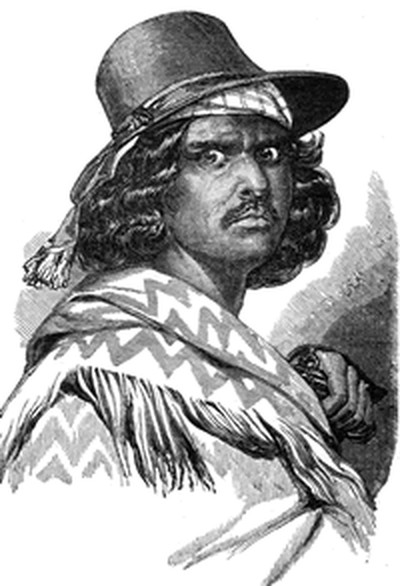
No verified photograph of Murrieta exists. The closest thing to a contemporary likeness is an engraving by artist Thomas Armstrong, published in the Sacramento Union within weeks of his reported death. It is an illustration, not a photograph, and one nobody claims was drawn from life. A separate image sometimes circulated online as "the" Murrieta photograph (a small tintype long associated with a Gold Country museum collection) has its own dating problem: tintypes and ambrotypes weren't in use until a few years after the incident its own origin story places it in, one more reason historians treat it, like most of the Murrieta record, with real skepticism.
A Reported Death, Not a Confirmed One
In July 1853, a state-authorized ranger company led by Harry Love reported killing a bandit identified as Joaquín Murrieta along with an associate, Bernardino "Three-Fingered Jack" Garcia, near the Panoche Pass. As proof, the rangers preserved Murrieta's severed head and Garcia's hand in a jar of alcohol and collected a $6,000 reward the state had offered for Murrieta's capture, dead or alive. Whether the head genuinely belonged to Murrieta — or even whether "Joaquín Murrieta" as popularly described was a single real person rather than a composite of several bandits blamed collectively — remains disputed among historians to this day.
Love went on to profit further from the trophy, charging admission to view the jarred head on a tour of California mining camps and San Francisco saloons. It eventually entered a San Francisco physician's private museum, where it remained on display for roughly three decades until it was destroyed in the fires that followed the 1906 earthquake.
Why the Legend Endured
Regardless of how much of the traditional story holds up, Murrieta became an enduring folk-hero figure, particularly framed in later retellings as a symbol of Californio and Mexican-American resistance to the dispossession and violence many faced during the Gold Rush years. That symbolic role, more than any settled historical record, is why his name has persisted as prominently as it has.
Frequently Asked Questions
Was Joaquín Murrieta a real person?
Almost certainly some real events and person(s) underlie the legend, but the popular Murrieta story is heavily embellished, largely traced to a sensationalized 1854 pulp biography. Historians dispute how much of the traditional narrative is verifiable, and some argue "Joaquín Murrieta" may represent a composite of several bandits rather than one documented individual.
How did Joaquín Murrieta reportedly die?
In July 1853, a California ranger company led by Harry Love reported killing a bandit they identified as Murrieta near Panoche Pass and preserved his severed head in a jar of alcohol to claim the state's $6,000 reward. Whether the head was genuinely his remains disputed.
What happened to Murrieta's severed head?
Harry Love toured California mining camps and San Francisco charging admission to view it, before it was acquired by a San Francisco physician's private museum. It stayed on display there for roughly 30 years until it was destroyed in the fires following the 1906 earthquake.
Why is Joaquín Murrieta considered a folk hero?
Later retellings framed him as a symbol of resistance to the violence and dispossession Californio and Mexican-American residents faced during the Gold Rush, a symbolic role that has outlasted the historical uncertainty around the underlying facts.
Is the Murrieta legend based on a true story?
In part, almost certainly: banditry and anti-Mexican violence were both real features of the early Gold Rush years. But the specific narrative most commonly told is not considered reliable history by most historians, who trace much of it to sensationalized 1850s pulp fiction rather than documented fact.
Who wrote the original Joaquín Murrieta story?
The Life and Adventures of Joaquín Murieta (1854) was written by John Rollin Ridge, a Cherokee author publishing under the name Yellow Bird. It is now recognized as one of the first novels published by a Native American writer. But its sensationalized, largely unverifiable account is the direct source of most of the popular Murrieta legend.
Does a real photograph of Joaquín Murrieta exist?
No verified one. The closest contemporary likeness is an 1851 engraving by Thomas Armstrong. A tintype sometimes shared online as "the" Murrieta photograph is authenticity-disputed: that photographic process didn't exist yet at the time its own origin story claims it was taken, which is one more reason historians treat it skeptically.
Is the city of Murrieta, California named after this outlaw?
No, a common mix-up. The city of Murrieta is named after Juan Murrieta, an unrelated rancher and later Los Angeles County sheriff's deputy who bought land in the area in the 1870s-80s. He has no connection to the bandit Joaquín Murrieta.
More Outlaws & Frontier Figures
- Tiburcio Vásquez — 1835–1875
- Black Bart — 1875–1883 (active)