

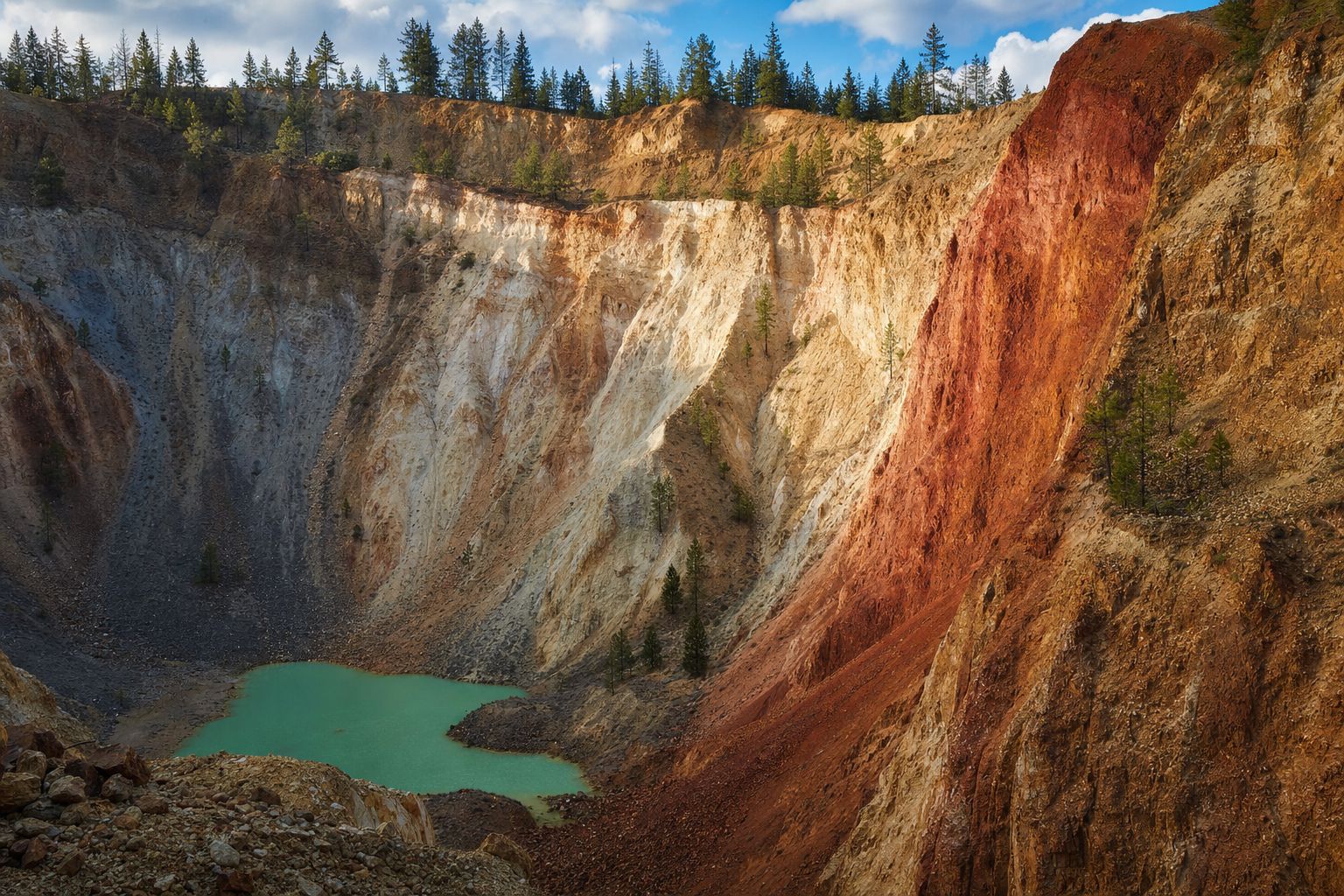
Malakoff Diggins looks less like a mine and more like a canyon that shouldn’t exist: a vast man-made pit carved out of the Sierra foothills by the most destructive mining technique the Gold Rush ever produced.
Blasting Away a Hillside
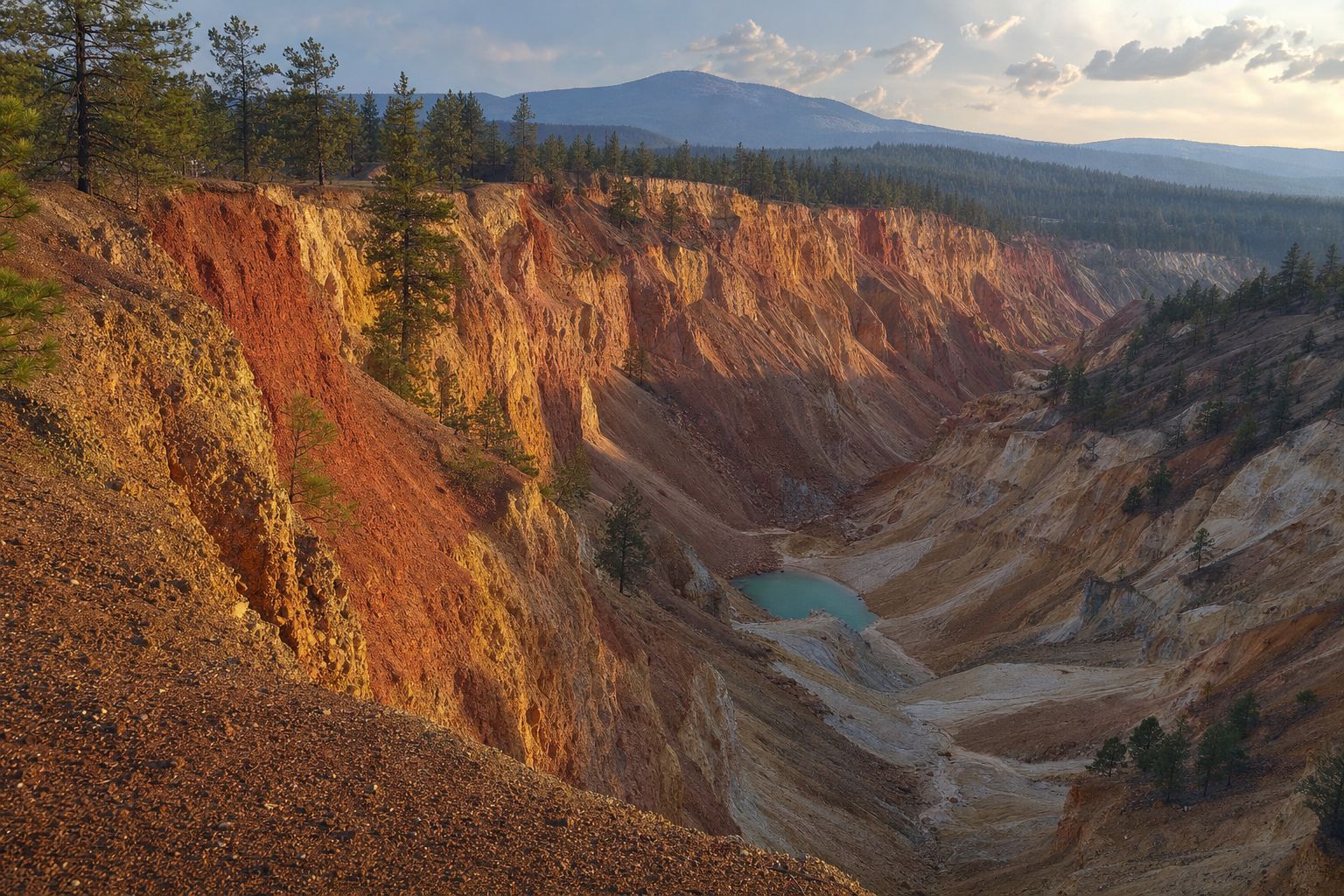
Hydraulic mining used powerful water cannons, called monitors, to blast entire hillsides apart in search of gold-bearing gravel deposits left over from ancient riverbeds. At Malakoff Diggins, operated by the North Bloomfield Gravel Mining Company, this technique carved out what became the largest hydraulic mine in California, a canyon roughly a mile long, with cliff walls exposing colorful eroded strata still visible today.
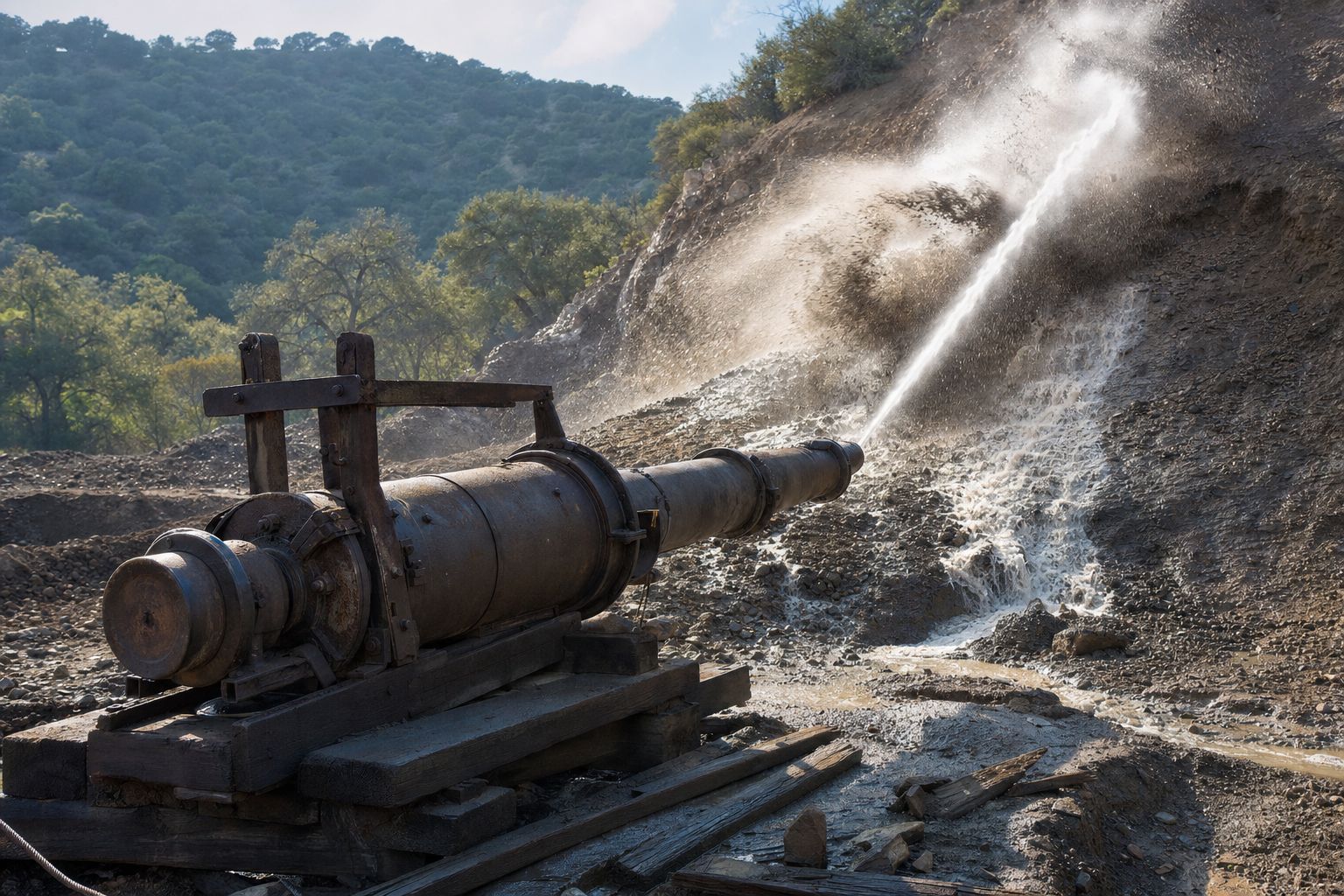
The Largest Hydraulic Mine on Earth
The North Bloomfield Gravel Mining Company formed in 1866 when a local miner consolidated dozens of individual gravel claims (including the Malakoff) with San Francisco financial backing. Its name, oddly, has nothing to do with California: it commemorates the 1855 fall of Russia's Fort Malakoff during the Crimean War, a battle its French miners wanted to memorialize. By full operation in 1876, the company ran the mine around the clock in two twelve-hour shifts and, in 1868 alone, employed over 800 Chinese laborers alongside some 300 white workers; no other hydraulic operation in the world matched it for scale or expense.
Over nearly 44 years of operation, the company tore 41 million cubic yards of earth and gravel out of the mountainside, recovering more than $13.5 million in gold before finally shutting down in 1910 — outlasting the 1884 Sawyer Decision that had already ended large-scale hydraulic mining almost everywhere else in the state.
Debris Downstream
Hydraulic mining's destructive power didn't stop at the hillside. Millions of tons of gravel, sand and mining debris washed downstream into Central Valley rivers, raising riverbeds, worsening flooding, and burying farmland under mining sediment: a direct conflict between mining interests and the valley's growing agricultural economy.
The Sawyer Decision
That conflict came to a head in Woodruff v. North Bloomfield Gravel Mining Co., decided by federal judge Lorenzo Sawyer in 1884. The ruling (now commonly known as the Sawyer Decision) didn't outlaw hydraulic mining itself, but banned dumping its debris into California's rivers, and is widely regarded as one of the earliest major environmental law rulings in United States history. Because river-dumping was central to the method's economics almost everywhere it was practiced, the ruling ended large-scale hydraulic mining across most of the state almost overnight, but not at Malakoff Diggins itself: the North Bloomfield company kept mining there under contained-debris conditions for another 26 years, finally closing in 1910. Hydraulic mining on this scale belongs to the same Gold Rush-era boom covered on our American California & the Gold Rush era page.
What makes Malakoff Diggins worth visiting today isn't a restored town or a reconstructed fort, but the scar itself: a mile-long, multicolored canyon that exists nowhere near a natural landform, carved entirely by water cannons in under half a century. Few places in California make the sheer physical scale of Gold Rush-era mining as immediately visible, and fewer still sit at the origin point of the legal precedent that eventually reined that scale in. Walking the canyon rim today means standing inside both the technology and the environmental reckoning it provoked, in the same place.
Frequently Asked Questions
What is hydraulic mining?
Hydraulic mining used powerful water cannons, called monitors, to blast apart entire hillsides in search of gold-bearing gravel from ancient riverbeds, a far more destructive technique than panning or sluicing, and Malakoff Diggins was the largest such operation in California.
What is the Sawyer Decision?
The Sawyer Decision refers to Woodruff v. North Bloomfield Gravel Mining Co., a federal ruling by Judge Lorenzo Sawyer in 1884 that effectively banned dumping hydraulic mining debris into California's rivers. It is widely regarded as one of the earliest major environmental law rulings in US history.
Why was hydraulic mining banned?
Millions of tons of gravel, sand and debris from hydraulic mining operations washed downstream into Central Valley rivers, raising riverbeds, worsening flooding, and burying farmland: a direct conflict with the valley's agricultural interests that the Sawyer Decision resolved in the farmers' favor by banning river-dumping specifically, not hydraulic mining as a technique.
Did Malakoff Diggins keep operating after the Sawyer Decision?
Yes, for another 26 years. The 1884 ruling banned dumping debris into rivers, and most hydraulic operations statewide relied on river-dumping to be economical — but the North Bloomfield Gravel Mining Company kept mining at Malakoff under contained-debris conditions until it finally closed in 1910.
What does Malakoff Diggins look like today?
A vast man-made canyon roughly a mile long, with cliff walls exposing colorful, multicolored eroded earth and gravel strata — a dramatic, almost otherworldly landscape that is the direct physical result of the hydraulic mining that once took place there.
More Historic Parks
- Columbia State Historic Park — Tuolumne County
- Sutter's Fort State Historic Park — Sacramento
- Fort Ross State Historic Park — Sonoma Coast