
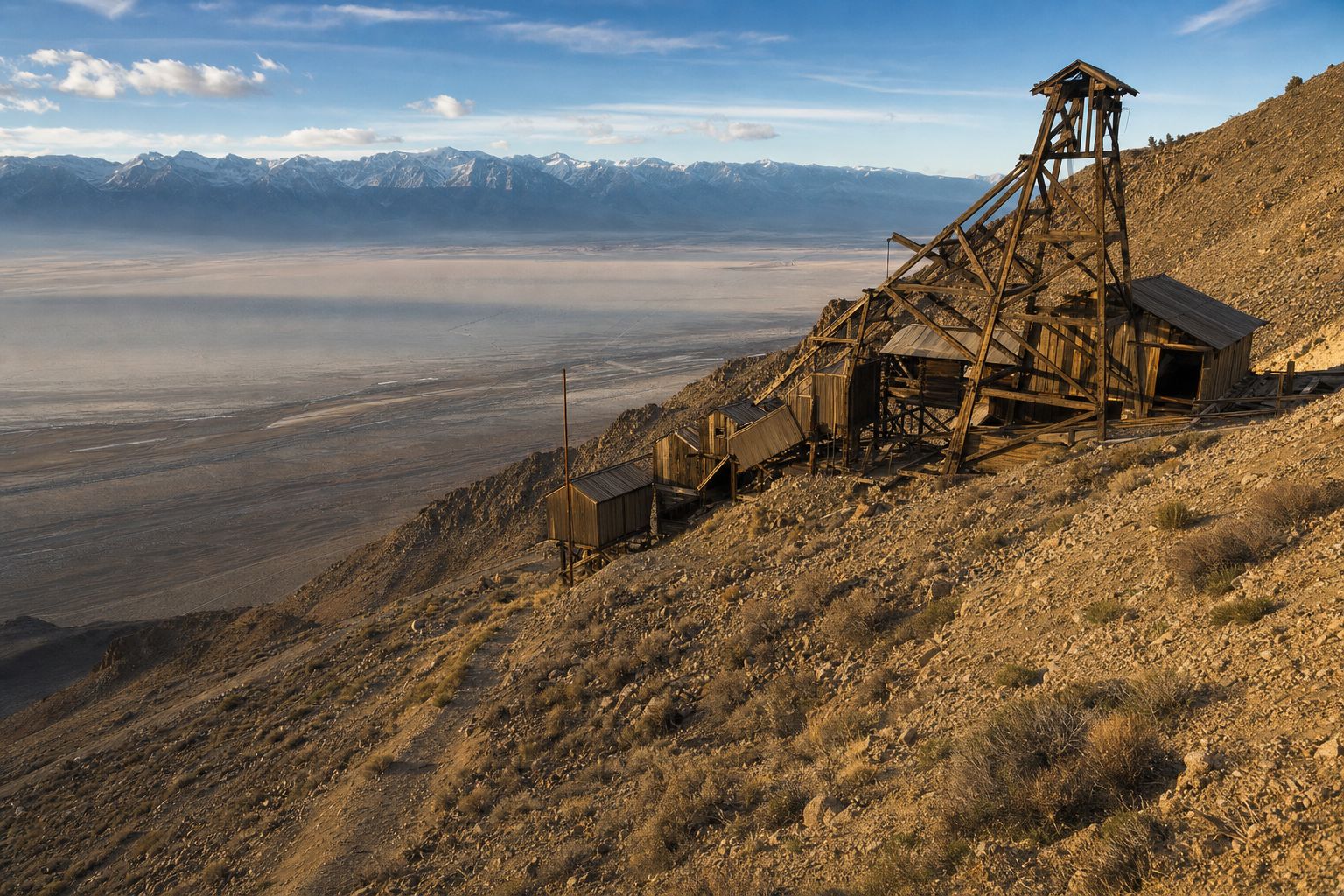
Cerro Gordo clings to a steep, dry mountainside high above the Owens Valley — remote even by ghost-town standards, and disproportionately important to California history for a camp its size, because of where its silver ended up.
A Discovery in the Inyo Mountains
Silver-lead ore was discovered at Cerro Gordo in 1865, credited to prospector Pablo Flores, who gave the site its name (Spanish for "Fat Hill") for the sheer richness of the deposits near Buena Vista Peak. The mines developed there over the following decade became some of the most productive in the region under the management of Mortimer Belshaw, who arrived from San Francisco in 1868 and built a toll road (the "Yellow Grade Road") to move ore and supplies up and down the mountain.
A Furnace and a Toll Road
Belshaw's real contribution wasn't just capital — it was engineering. He designed and built an improved blast furnace, later called the Belshaw Furnace, that extracted lead and silver efficiently from ore grades earlier, cruder methods couldn't process economically. Getting the resulting bullion down from Cerro Gordo's 8,500-foot elevation was its own problem, solved by the eight-mile Yellow Grade Road Belshaw built and tolled, named for the yellow-tinted rock his crews had to cut through, not for anything else. Controlling the only practical route down the mountain let Belshaw control, and profit from, virtually every ounce of bullion that left it.
The investment paid off dramatically: by 1869, Cerro Gordo was the leading source of both lead and silver in the entire United States, and production peaked in 1874 at roughly eighteen tons of silver-lead bullion a day.
The Los Angeles Connection
Cerro Gordo’s real historical significance lies less in the camp itself than in where its silver bullion went. Ore and bullion from Cerro Gordo were shipped down to the small settlement of Los Angeles for onward transport — freight hauling that historian Remi Nadeau, in his history of the city's founding families, City-Makers, credits as "the silver thread" that helped finance Los Angeles's rise into a real city, at a time when it was still a modest town. Nadeau had a personal stake in the story: his own great-great-grandfather, freighter Remi Nadeau, was among the men who actually drove the bullion wagons down from the mountain.
Decline and Recent Preservation
Cerro Gordo’s richest ore was largely worked out by the 1880s, though sporadic smaller-scale mining, including a brief zinc-mining episode during the First World War, continued into the twentieth century. The site passed through private ownership for decades afterward.
A Fire, and a Very Public Rebuild
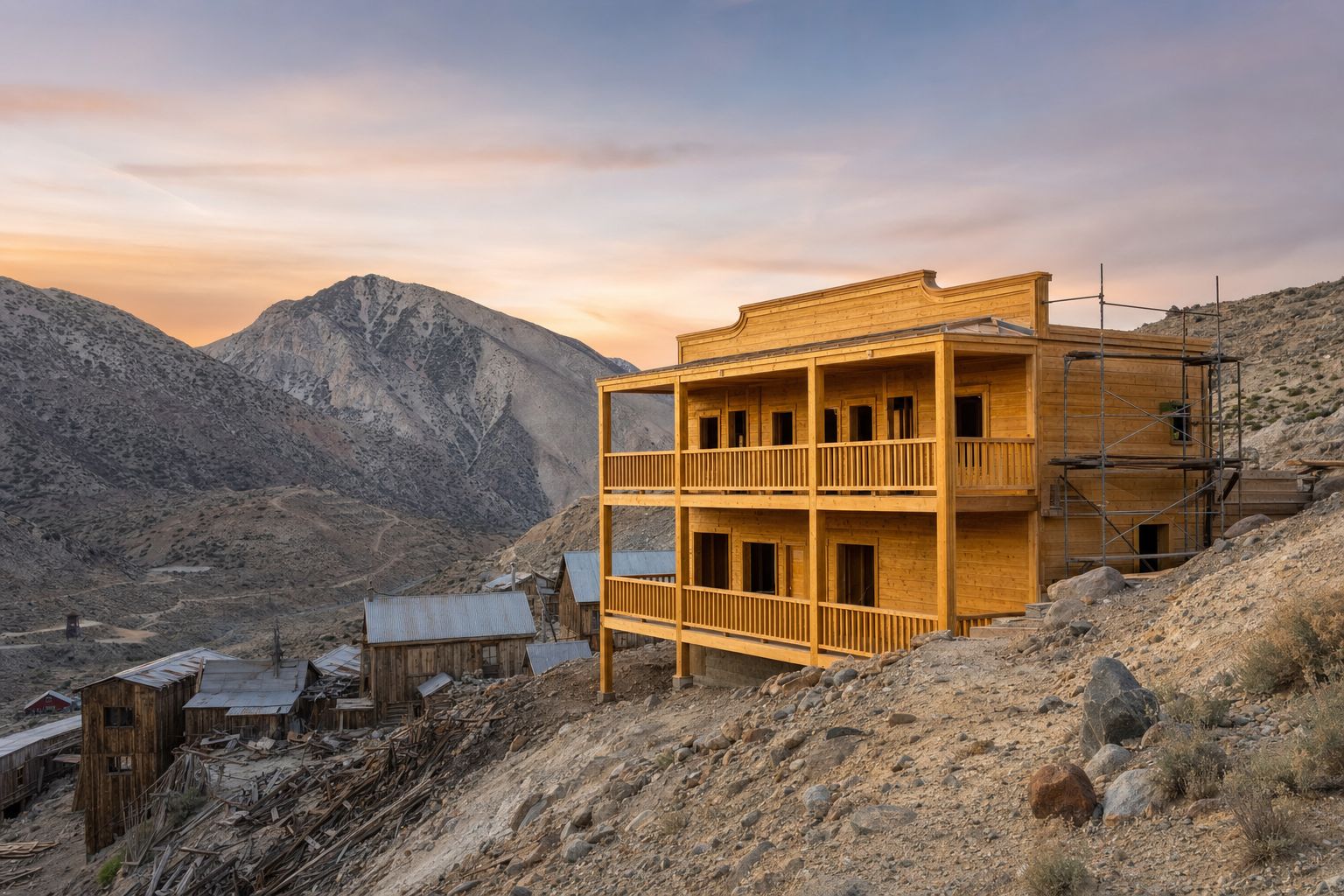
In 2018, Brent Underwood and Jon Bier bought the town for $1.4 million with a group of investors, intending to restore and reopen it. On June 15, 2020 — 149 years to the day after it first opened — the American Hotel, one of the site's signature buildings, burned to the ground in a suspected electrical fire that also destroyed an icehouse and a residence. Rather than abandon the project, Underwood documented the rebuilding effort publicly online, and a reconstructed American Hotel was fully framed by 2024 and completed in 2025, keeping Cerro Gordo from disappearing entirely, and turning its restoration into an unusually public one.
Frequently Asked Questions
Who discovered silver at Cerro Gordo?
Silver-lead ore was discovered at Cerro Gordo in 1865, credited to prospector Pablo Flores, who named the site (Spanish for "Fat Hill") for the richness of its deposits. Mortimer Belshaw later developed the mines into major producers and built the toll road used to move ore off the mountain.
What was the Yellow Grade Road?
An eight-mile toll road Mortimer Belshaw built to move silver-lead bullion down from Cerro Gordo's 8,500-foot elevation. It's named for the yellow-tinted rock cut through during construction, not for any other reason. By controlling the only practical route down, Belshaw controlled the profits from nearly everything the mountain produced.
How is Cerro Gordo connected to Los Angeles?
Silver bullion mined at Cerro Gordo was shipped down to the small settlement of Los Angeles for onward transport during the 1870s. Historians widely credit that trade with meaningfully contributing to the young city’s economy at a formative stage of its growth.
Is Cerro Gordo abandoned today?
Largely uninhabited but not abandoned — new owners bought the site in 2018 for $1.4 million and have been actively restoring it, including rebuilding the American Hotel after it burned down in a 2020 fire.
What happened to the American Hotel at Cerro Gordo?
It burned to the ground on June 15, 2020, in a suspected electrical fire, 149 years to the day after it first opened. Owner Brent Underwood documented the rebuilding process publicly, and a reconstructed hotel was completed in 2025.
Where is Cerro Gordo located?
Cerro Gordo sits high in the Inyo Mountains in Inyo County, overlooking the Owens Valley near Lone Pine, California.
What was mined at Cerro Gordo?
Primarily silver-lead ore, discovered in 1865. A brief zinc-mining episode also took place at the site during the First World War, well after the main silver boom had ended.
More Ghost Towns
- Dogtown — Butte County, Sierra Nevada foothills
- Bodie — Mono County, eastern Sierra Nevada
- Calico — San Bernardino County, Mojave Desert
- Randsburg — Kern County, Mojave Desert
- Stirling City — Butte County, Sierra Nevada foothills