

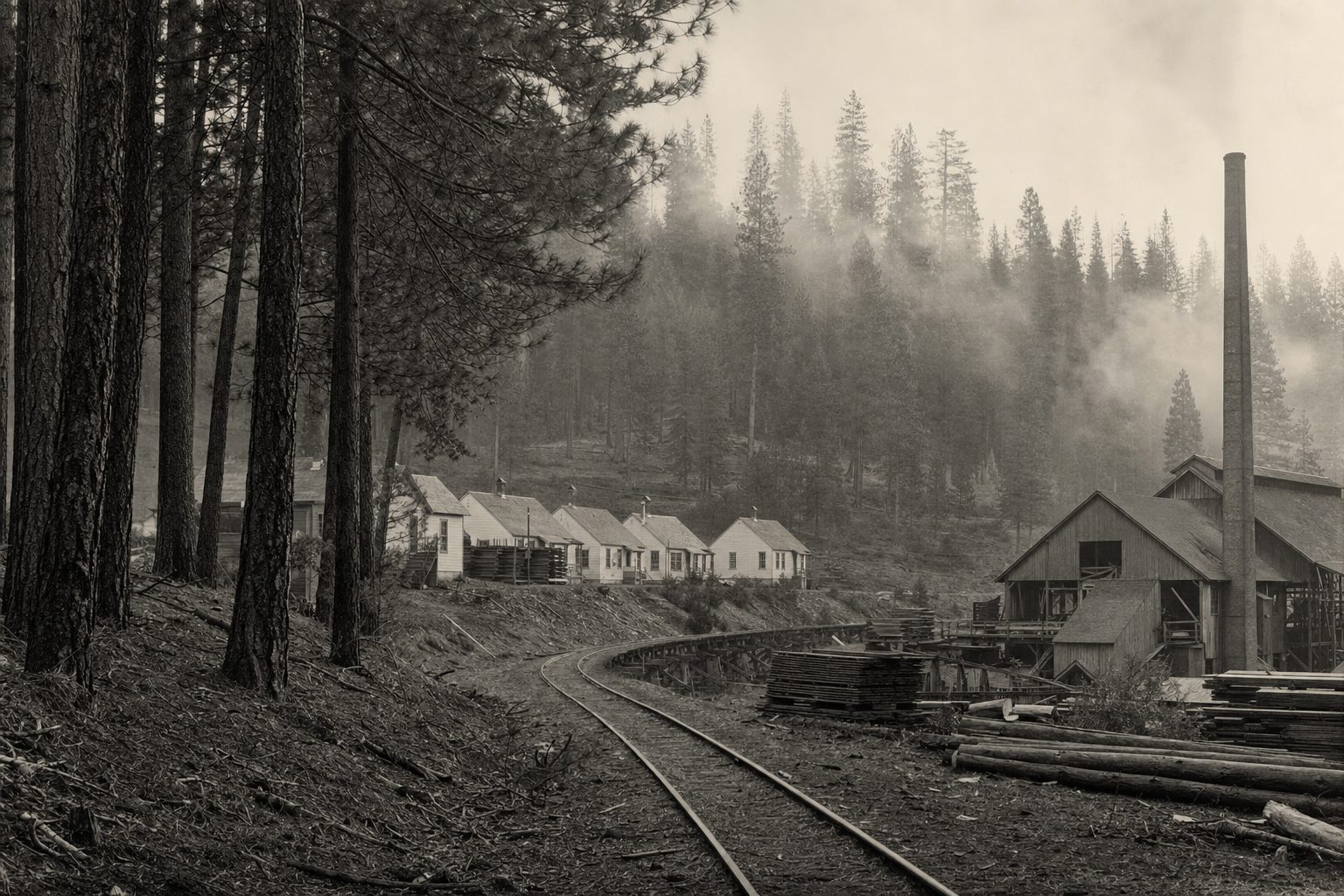
Stirling City wasn't a mining camp that grew organically: it was built, deliberately and all at once, by a match company that needed a sawmill and a railroad to reach it. Both outlasted the industry that justified them by decades.
A Company Town Built by Diamond Match
Between 1901 and 1904, the Diamond Match Company bought roughly 40,000 acres of virgin timberland in the Ransey Bar–Kimshaw area of the Butte County foothills and set out to build what it needed to log it: a sawmill, a town for the workers, and a railroad to move both lumber and people. The town itself was laid out from nothing: six blocks by five, with water, electricity, graded streets, sidewalks and sewers built in from the start, unusually complete infrastructure for a brand-new company town. It took its name from the "Stirling" boilers among the first equipment to arrive on site.
Diamond Match was already a major national manufacturer of safety matches by the time it moved into California timber. Buying its own mill and forestland let the company control the supply of matchwood and construction lumber directly, rather than depend on outside suppliers for the raw material its main business needed.
The Railroad That Built It
To reach the new mill, Diamond Match financed the Butte County Railroad, incorporated in March 1902 and completed in June 1904, a 31.5-mile line running up from Chico into the foothills. Regular passenger service between Chico and Magalia began on November 2, 1903, meaning the same tracks that served Stirling City's sawmill also connected directly to the Dogtown gold camp's own successor town, tying two of this site's Butte County stories together on one rail line. The mill itself, once running, was described at the time as the most modern sawmill in California.
From Company Railroad to Southern Pacific
The Butte County Railroad operated as a Diamond Match subsidiary from 1903 to 1915, after which it was absorbed into the Southern Pacific system as the Stirling City Branch. Under Southern Pacific, the line kept running lumber and freight traffic for decades longer than the original company town model would have supported on its own.
The Mill Closes, the Rails Come Up
A 1931 fire destroyed most of the town's original buildings, a hazard common to lumber towns built largely of their own product. Stirling City rebuilt and kept running for another quarter-century before the mill's eventual closure.
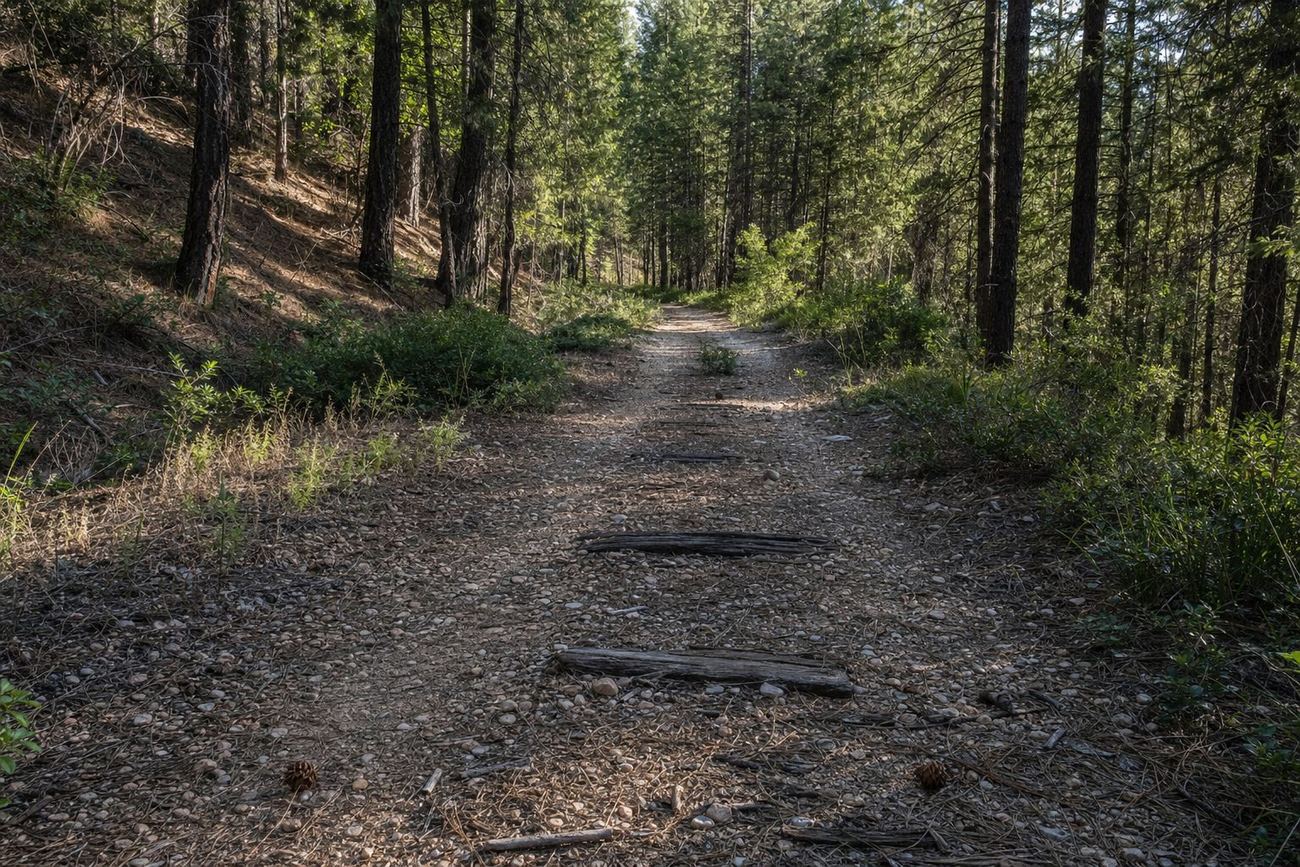
The Stirling City sawmill shut down for good on January 31, 1958, and the last train ran the branch line in 1974 before the tracks were finally pulled up. Much of the old railbed has since become a hiking and rail-trail corridor through the same Butte County foothills. Unlike most company towns built around a single industry, Stirling City itself didn't empty out when the mill and railroad closed: it has held on as a small, still-inhabited community on Paradise Ridge into the present day, counted at 469 residents in recent estimates, up from 300 at the 2020 census.
Frequently Asked Questions
What was the Butte County Railroad?
A 31.5-mile line financed by the Diamond Match Company, incorporated in March 1902 and completed in June 1904, running from Chico to the company's new sawmill at Stirling City. It operated as a Diamond Match subsidiary until 1915, then became Southern Pacific's Stirling City Branch until the line closed in 1974.
Why was Stirling City built?
The Diamond Match Company bought about 40,000 acres of timberland in the Butte County foothills between 1901 and 1904 and built Stirling City from scratch (six blocks by five, with water, electricity and sewers included from the start) to house the workers at its new sawmill.
Where does the name "Stirling City" come from?
From the "Stirling" boilers among the first equipment installed at the new sawmill.
Is Stirling City still there today?
Yes. Unlike most single-industry company towns, Stirling City never emptied out after its mill closed in 1958. Recent estimates put its population at 469, up from 300 at the 2020 census.
How is Stirling City connected to Dogtown?
The Butte County Railroad's passenger service, which began running between Chico and Magalia on November 2, 1903, connected Stirling City directly to Magalia, the town that grew out of the old Dogtown gold camp covered elsewhere in this directory.
Can you still see the old railroad route?
Much of the former Butte County Railroad / Southern Pacific Stirling City Branch right-of-way, abandoned after the last train ran in 1974, has since been converted into a hiking and rail-trail corridor through the Butte County foothills.
Did Stirling City ever burn down?
A 1931 fire destroyed most of the town's original buildings, a common hazard for lumber towns built largely of their own product. The town rebuilt and the mill kept running for another 27 years before closing for good in 1958.
More Ghost Towns
- Dogtown — Butte County, Sierra Nevada foothills
- Bodie — Mono County, eastern Sierra Nevada
- Calico — San Bernardino County, Mojave Desert
- Cerro Gordo — Inyo County, Inyo Mountains
- Randsburg — Kern County, Mojave Desert