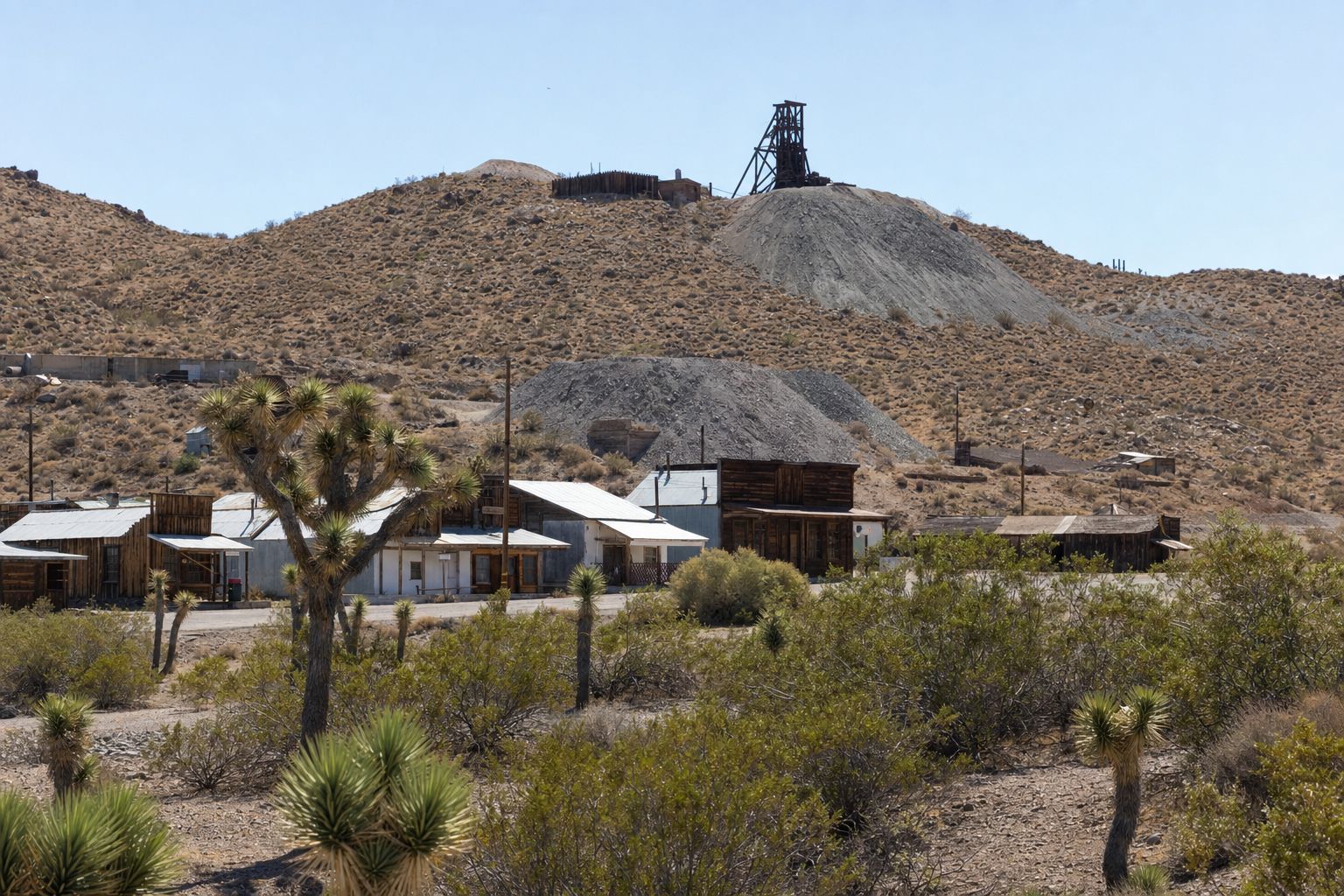
Randsburg is the exception on this list: a Gold Rush-era desert mining town that boomed, declined, and then simply kept going at a much smaller scale, rather than emptying out completely.
Gold at the Yellow Aster
Gold was discovered in April 1895 by prospectors Singleton Burcham and Charles Mooers, who traced a vein surfacing near the top of Rand Mountain and formed the Yellow Aster Mining and Milling Company to work it. The discovery is significant enough that the surrounding district (Randsburg, joined the following year by the supply town of Johannesburg and, later, Red Mountain, together sometimes called the "Rand" or "tri-city" area) is registered in its own right as California Historical Landmark No. 938, the state's own record noting the additional silver and, later, tungsten production from deposits at nearby Atolia.
By the end of 1897 the district had already produced more than $600,000 in gold, almost all of it from the Yellow Aster. A 100-stamp mill went up at the mine in 1901 to keep pace, and over the life of the operation the Yellow Aster alone yielded more than $20 million in gold, making it the richest gold mine in Southern California history, with by-then-booming Randsburg supporting a population over 3,500 by 1899.
A Town That Didn’t Fully Empty Out
Unlike Bodie or Calico, Randsburg never underwent a single dramatic bust. Small-scale gold mining continued intermittently for decades after the initial boom, and enough residents stayed on (through later gold-price fluctuations and periodic renewed interest in the district’s claims) that Randsburg has retained a small, year-round population into the present day, making it less a true "ghost town" than a much-diminished but still-living one.
The numbers tell the story: from over 3,500 residents at the 1899 peak, the district has shrunk to a small fraction of that today: neighboring Johannesburg counted just 113 residents at the 2020 census, down from 172 a decade earlier, and Randsburg itself is smaller still. It's nowhere near the boomtown it once was — but unlike Bodie, it never emptied out completely.
Still Open for Business
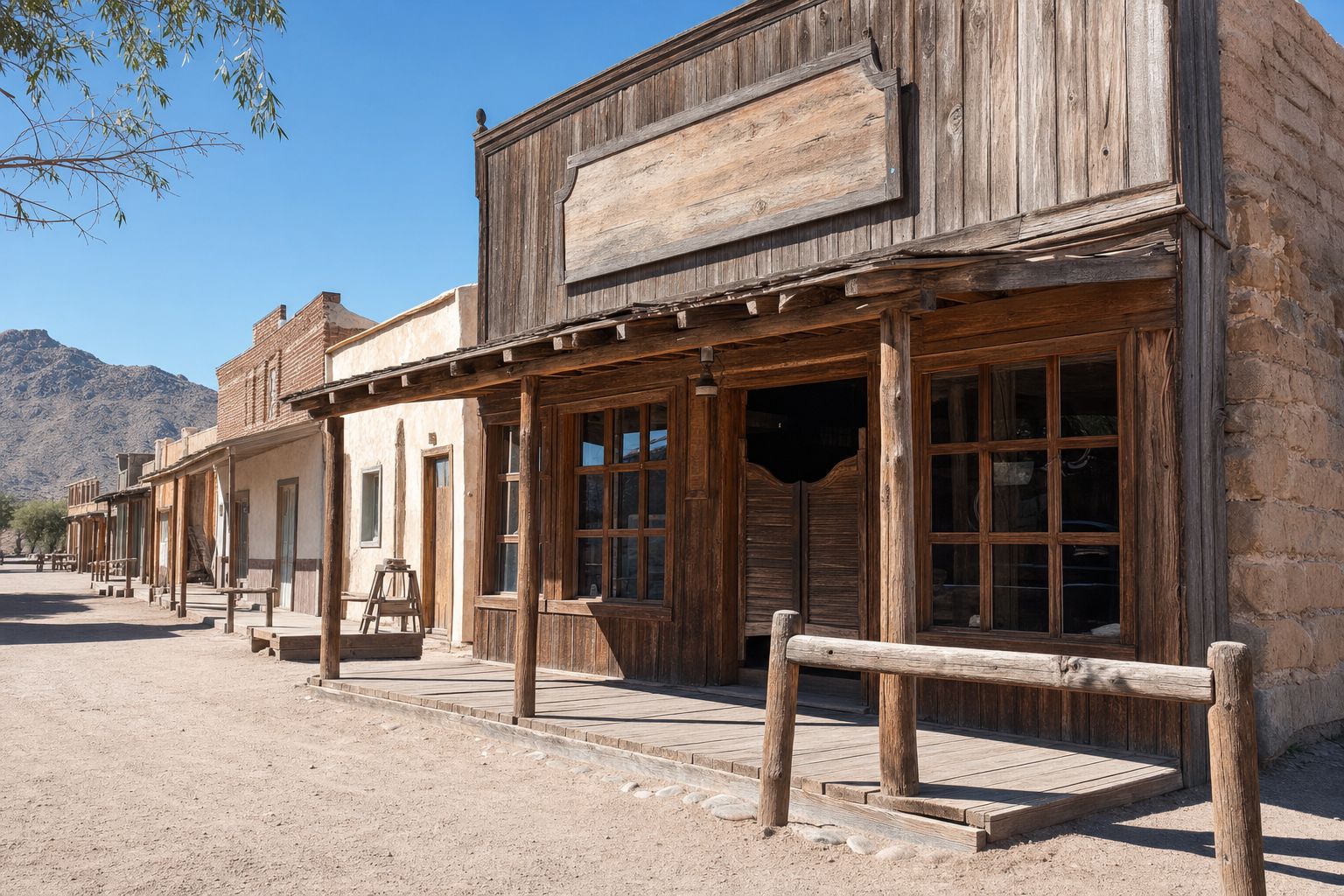
Randsburg's main street still runs on some of the same buildings that served the original boom. The White House Saloon has operated continuously since 1897, and the old Randsburg General Store (now trading as The Vault) still runs a soda fountain recognized as one of the oldest in North America, alongside antique shops selling Gold Rush-era relics and a small desert museum devoted to the Rand Mining District's history. It's a rare thing among California's mining towns: a main street where you can still buy a drink in the same room the miners did. Randsburg's 1895 strike came late in the boom-and-bust cycle covered in full on our American California & the Gold Rush era page.
Randsburg sits in an unusual middle ground among the six towns covered in this directory: not preserved as a museum piece the way Bodie is, not restored into a tourist attraction the way Calico was, and not fully abandoned either. It simply never stopped being a real, if much smaller, town, which means a visit here looks less like touring a historic site and more like passing through a place that happens to still be using its 1890s buildings for their original purposes. That ordinary continuity, rather than any single dramatic event, is what actually makes Randsburg the outlier on this list.
Frequently Asked Questions
When was Randsburg founded?
Randsburg was founded in 1895, following the discovery of gold at what became the Yellow Aster Mine, part of the Rand Mining District in the Mojave Desert.
How much gold did the Yellow Aster Mine produce?
More than $20 million over the life of the mine, making it the richest gold mine in Southern California history. It was discovered in April 1895 by prospectors Singleton Burcham and Charles Mooers, and a 100-stamp mill was added in 1901 to keep pace with production.
Is Randsburg a true ghost town?
Not quite — unlike most of the towns on this list, Randsburg retains a small, year-round population today. Small-scale mining continued intermittently for decades, and enough residents stayed on that the town never fully emptied out.
How many people live in Randsburg today?
A small fraction of its 1899 peak of 3,500: neighboring Johannesburg counted 113 residents at the 2020 census, down from 172 a decade earlier, and Randsburg itself is smaller still.
What other towns were part of the same mining district as Randsburg?
Randsburg was part of the wider Rand Mining District along with the nearby towns of Johannesburg and Red Mountain, sometimes referred to together as the "Rand" or "tri-city" area. The district also produced silver, and later tungsten from deposits at nearby Atolia.
Are any original businesses still open in Randsburg?
Yes. The White House Saloon has run continuously since 1897, and the old general store (now called The Vault) still operates a soda fountain recognized as one of the oldest in North America, alongside antique shops and a small mining-district museum.
Where is Randsburg located?
Randsburg is in Kern County, in the Mojave Desert region of Southern California.
More Ghost Towns
- Dogtown — Butte County, Sierra Nevada foothills
- Bodie — Mono County, eastern Sierra Nevada
- Calico — San Bernardino County, Mojave Desert
- Cerro Gordo — Inyo County, Inyo Mountains
- Stirling City — Butte County, Sierra Nevada foothills